by ANDREW MARKS (6 Dec)
Sympathetic noises from Congress on rescue for Detroit Three carmakers temper fears
FOR the whole of this week, Wall Street had been trying hard to hold on to the little optimism eked out from the most recent wave of government capital injections.
That effort seemingly came to an abrupt end yesterday.
In the face of a shockingly bad November jobs report, the mood of stockmarket investors nosedived as news that the US economy shed 533,000 jobs, the worst single month since 1974, filtered through.
On average, forecasts had expected a loss of about 400,000 jobs. The unemployment rate rose to 6.7 per cent from 6.5 per cent in October. The government added that it was revising its jobs data for September and October, loading on 199,000 more layoffs than previously thought. That brings the total reduction in US non-farm payrolls for the last three months to 1.256 million, with almost two million shed in the year so far.
Investors reacted to the data in predictable fashion. Stocks slid shortly after the opening bell, with the Dow falling 80 points, or one per cent, in the first minutes of trading. That widened to a loss of 220 points by 11.30 in the morning as the blue chip index hit 8,155.
But there is a glimmer of hope. Wall Street seemed encouraged by remarks at the opening to yesterday's Congressional hearings for a bailout for the Big Three carmakers.
Barney Frank, chairman of the House financial services committee, said: 'In the midst of the worst economic situation since the Great Depression, letting the Big Three fail is simply unacceptable. Any effort to resist a rescue of the auto industry in the face of such a massive jobs crisis must fall by the wayside,' he said.
On Thursday afternoon, stocks took a hit in the final hour of trading, as investors pulled money off the table before yesterday's jobs report, not wanting to risk losing all their profits of recent days.
Economist Joel Naroff, president of Naroff Economic Advisors, had anticipated a record layoff number following the Wednesday release of the Institute for Supply Management's Non-Manufacturing index November numbers, which recorded it's largest monthly decline since the survey was begun in 1997.
'This is obviously a bad number, showing how hard a hit the economy is taking. But you have to remember this is a lagging indicator and it appears that businesses are adjusting extremely rapidly to the real time information about the problems.
That may be compressing the time it takes to downsize when a recession hits. As a consequence, the data is deteriorating more sharply than we are used to seeing,' he said.
As shocking as the number is, Mr Naroff thinks that the economy could also see an end to the huge losses in jobs and demand sooner than would typically be the case in a severe recession.
'It's like being hit by a hurricane. We have to ride out the intense storm, but the silver lining is we might get good weather sooner than history would indicate,' he said.
It will probably be weeks, if not months before the stock market will agree with Mr Naroff's positive analysis of the collapse in all the data.
Said Joe Battipaglia, investment strategist at Ryan, Beck, 'These awful numbers we're getting could be taken as indicating that the bottom is coming, but at this point, they could also be taken as a sign that we're in even worse shape than we believed.'
'That means stock market sentiment will continue to be highly volatile and subject to change with every new piece of significant data,' he said.
The severity of the jobs report has also raised expectations on Wall Street that Congress and the Treasury will keep GM and Chrysler in business while the debate over how to restructure the car industry gets aired.
'Everybody knows now that the automakers will get their loan - there's no choice, and this report also raises the certainty we'll get a huge stimulus programme, probably north of US$500 billion, once Mr Obama is inaugurated in January,' said Jim Awad, managing director of Zephyr Capital Management.
-Research Report by ANDREW MARKS (6 Dec)
Sunday, December 7, 2008

Saturday, December 6, 2008
Week when selling holds sway
by R SIVANITHY (6 Dec)
SHOCKING news that the US economy has been in a recession - defined as a general contraction in economic activity rather than two consecutive quarters of declines - for a year now, the failure of US carmakers to convince the government to bail them out and a sharp drop in trading volume were three of the main features of the past week.
The fourth was the 'buy the index in the morning, and sell in the afternoon' trading pattern that was evident in the final three days of the week, each time because of expectations that Wall Street would tank later that evening.
As it turned out, though, the selling outweighed the buying, insofar as the STI was concerned, the benchmark ending the week 15.49 points higher yesterday but losing 73 points or 4.2 per cent over the five days to 1,659.17.
This wiped out the 70 points gained over the previous week, which was mostly likely through month-end window-dressing.
Blue chips in play throughout this week included SingTel following an Investor Day, the banks and the thinly traded Jardine group. In yesterday's session, for example, Jardine Matheson's US$0.44 rise to US$16.24 came with just 258,000 shares traded but added 2.2 points to the STI.
Property stocks had a poor five days, the FT Real Estate Index losing almost 6 per cent. Financials were not far behind with the FT Financials Index dropping about 5 per cent.
Other than commodities, the main sector in play was a heavily battered China segment led by an oddly resurgent Cosco Corp that gained 16 cents or 23 per cent over the week to 87 cents despite a slew of 'sell' calls following a large order cancellation.
The bulk of daily volume was generated by brokers and house traders, with general public participation virtually zero. Yesterday's turnover of 867 million units worth $747 million was roughly in line with the week's average and low enough to suggest that any investor with money to invest has probably already gone on holiday.
More sobering outlook reports were issued over the week, among them Goldman Sachs' (GS) 'Many Rivers to Cross' and UBS Investment Research's (UBSIR) 'Navigating a Recession'.
The former said risks to growth are to the downside, notwithstanding countervailing policy actions, and this will increase risks to earnings. 'We expect a global recession in 2009 . . . we feel there are sufficient reasons to examine the possibility that this downturn will be more prolonged than currently expected.
These include (a) the negative momentum of consensus forecasts, (b) the size of the debt burden in the US and (c) the deleveraging experiences of Japan and Sweden in the 1990s,' said GS.
UBSIR said it thinks a rally of 15-20 per cent in Q1 '09 is possible purely because markets are oversold but its central thesis is for a 'grim economic outlook and high risk aversion'.
It said the market has not priced in the success of the two integrated resorts but, on the downside, investors should watch the job market - where UBSIR expects 30,000 jobs to be lost during the year.
On a more positive note, the broker said it has a fair value of 2,100 for the STI at year-end.
-Research Report by R SIVANITHY (6 Dec)
SHOCKING news that the US economy has been in a recession - defined as a general contraction in economic activity rather than two consecutive quarters of declines - for a year now, the failure of US carmakers to convince the government to bail them out and a sharp drop in trading volume were three of the main features of the past week.
The fourth was the 'buy the index in the morning, and sell in the afternoon' trading pattern that was evident in the final three days of the week, each time because of expectations that Wall Street would tank later that evening.
As it turned out, though, the selling outweighed the buying, insofar as the STI was concerned, the benchmark ending the week 15.49 points higher yesterday but losing 73 points or 4.2 per cent over the five days to 1,659.17.
This wiped out the 70 points gained over the previous week, which was mostly likely through month-end window-dressing.
Blue chips in play throughout this week included SingTel following an Investor Day, the banks and the thinly traded Jardine group. In yesterday's session, for example, Jardine Matheson's US$0.44 rise to US$16.24 came with just 258,000 shares traded but added 2.2 points to the STI.
Property stocks had a poor five days, the FT Real Estate Index losing almost 6 per cent. Financials were not far behind with the FT Financials Index dropping about 5 per cent.
Other than commodities, the main sector in play was a heavily battered China segment led by an oddly resurgent Cosco Corp that gained 16 cents or 23 per cent over the week to 87 cents despite a slew of 'sell' calls following a large order cancellation.
The bulk of daily volume was generated by brokers and house traders, with general public participation virtually zero. Yesterday's turnover of 867 million units worth $747 million was roughly in line with the week's average and low enough to suggest that any investor with money to invest has probably already gone on holiday.
More sobering outlook reports were issued over the week, among them Goldman Sachs' (GS) 'Many Rivers to Cross' and UBS Investment Research's (UBSIR) 'Navigating a Recession'.
The former said risks to growth are to the downside, notwithstanding countervailing policy actions, and this will increase risks to earnings. 'We expect a global recession in 2009 . . . we feel there are sufficient reasons to examine the possibility that this downturn will be more prolonged than currently expected.
These include (a) the negative momentum of consensus forecasts, (b) the size of the debt burden in the US and (c) the deleveraging experiences of Japan and Sweden in the 1990s,' said GS.
UBSIR said it thinks a rally of 15-20 per cent in Q1 '09 is possible purely because markets are oversold but its central thesis is for a 'grim economic outlook and high risk aversion'.
It said the market has not priced in the success of the two integrated resorts but, on the downside, investors should watch the job market - where UBSIR expects 30,000 jobs to be lost during the year.
On a more positive note, the broker said it has a fair value of 2,100 for the STI at year-end.
-Research Report by R SIVANITHY (6 Dec)
Thursday, December 4, 2008
Olam 041208
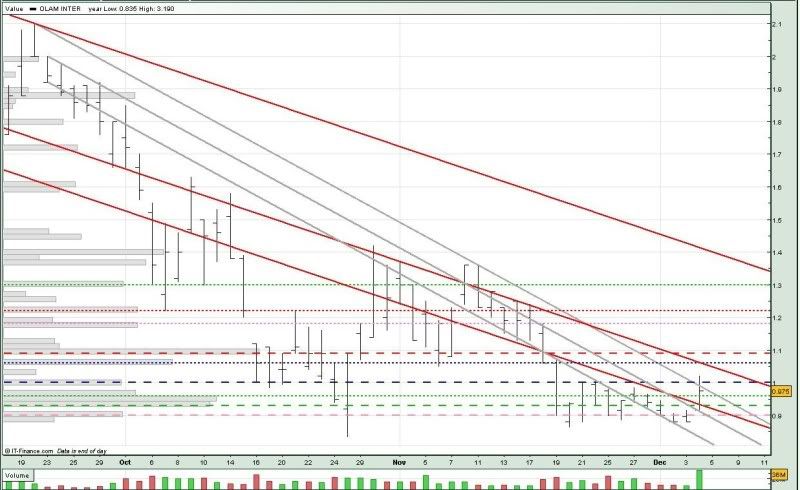
After trading sideways for more than the last 2 weeks, we finally saw some action today. Olam broke the long term downtrend resistance (now turned support - low red). Volume done today was also the most since 30 may 2008 (35.1m).
After breaking the 0.960 neckline (green ...), Olam went on to test the 1.00 resistance (blue --), before closing just above the 0.960 neckline. If Olam manages to continue to trade above the 0.960 neckline, we could see it test the 1.00 resistance very soon.
However, if Olam breaks the 0.960 support, we could see it revisiting the 0.930 support (green --).
For tomorrow :
Support @ 0.970 (upp grey), 0.960 (green ...), 0.930 (green --), 0.920 (low red), 0.900 (pink --), 0.890 (mid grey)
Resistance @ 1.00 (blue --), 1.05 (mid red), 1.06 (blue ...), 1.09 (red --)
After breaking the 0.960 neckline (green ...), Olam went on to test the 1.00 resistance (blue --), before closing just above the 0.960 neckline. If Olam manages to continue to trade above the 0.960 neckline, we could see it test the 1.00 resistance very soon.
However, if Olam breaks the 0.960 support, we could see it revisiting the 0.930 support (green --).

For tomorrow :
Support @ 0.970 (upp grey), 0.960 (green ...), 0.930 (green --), 0.920 (low red), 0.900 (pink --), 0.890 (mid grey)
Resistance @ 1.00 (blue --), 1.05 (mid red), 1.06 (blue ...), 1.09 (red --)
Noble Group 041208
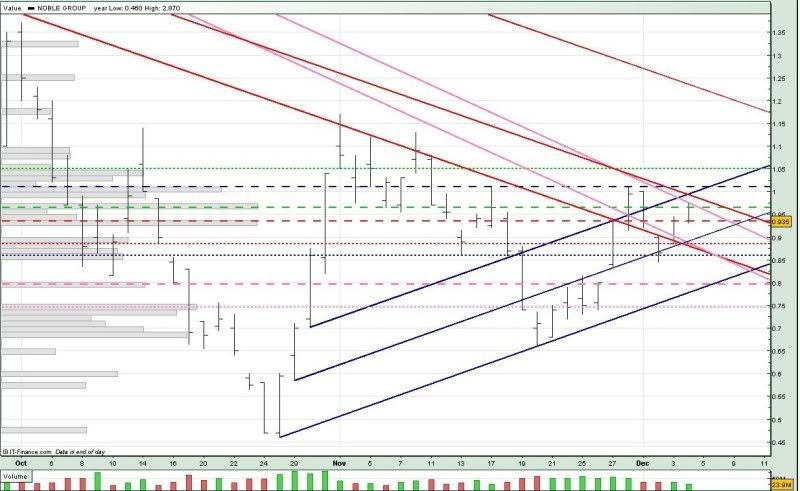
Although Noble Group is still trading within the uptrend channel (blue), it closed the day at its opening price, almost forming a Gravestone Doji. Noble Group retreated quite abit after failing to break the 1.01 resistance (blue --) last fri (28 nov).
If Noble Group manages to continue to trade within the uptrend channel (blue), we could be looking at Noble Group trading between the uptrend support (mid blue) and downtrend resistance (upp pink) as it tries to form a base.
For tomorrow :
Support @ 0.935 (red --), 0.900 (mid blue), 0.885 (red ...), 0.875 (low pink), 0.870 (low red), 0.860 (red ...)
Resistance @ 0.965 (upp pink, green --), 0.9825 (upp red), 1.01 (upp blue, blue --), 1.05 (green ...)
If Noble Group manages to continue to trade within the uptrend channel (blue), we could be looking at Noble Group trading between the uptrend support (mid blue) and downtrend resistance (upp pink) as it tries to form a base.

For tomorrow :
Support @ 0.935 (red --), 0.900 (mid blue), 0.885 (red ...), 0.875 (low pink), 0.870 (low red), 0.860 (red ...)
Resistance @ 0.965 (upp pink, green --), 0.9825 (upp red), 1.01 (upp blue, blue --), 1.05 (green ...)
Indofood Agri 041208
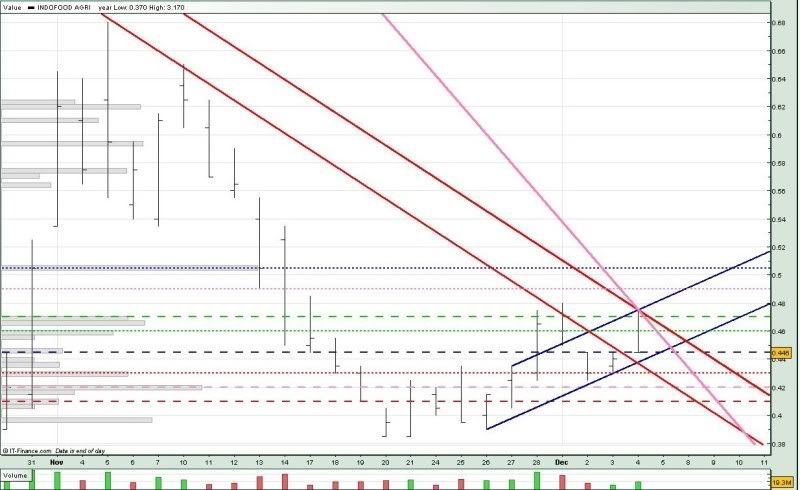
Indofood Agri failed to break the 0.470 resistance (green --) after testing for the third time today. Indofood Agri even closed at its opening price, forming a Gravestone Doji.
Since Indofood Agri has been on the uptrend since 26 nov, we could see some pulling back if it fails to hold onto its 0.445 support (blue --).
For tomorrow :
Support @ 0.445 (low blue, blue --), 0.430 (low red, red ...), 0.420 (pink --), 0.410 (red --)
Resistance @ 0.460 (upp pink, green ...), 0.465 (upp red), 0.470 (green --), 0.480 (upp blue)
Since Indofood Agri has been on the uptrend since 26 nov, we could see some pulling back if it fails to hold onto its 0.445 support (blue --).

For tomorrow :
Support @ 0.445 (low blue, blue --), 0.430 (low red, red ...), 0.420 (pink --), 0.410 (red --)
Resistance @ 0.460 (upp pink, green ...), 0.465 (upp red), 0.470 (green --), 0.480 (upp blue)
Cosco 041208
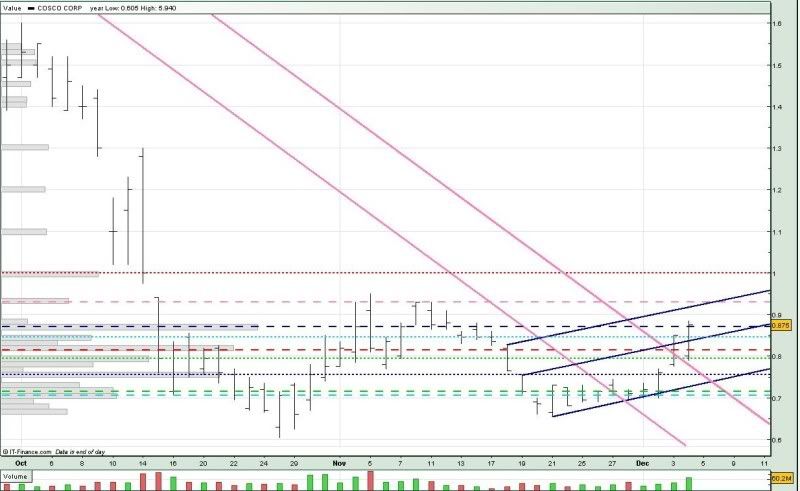
After breaking the long term downtrend resistance (upp pink) yesterday, Cosco continued its upward surge with almost twice of yesterday's volume done. However, Cosco did test the 0.795 support (green ...), before reversing and charged towards the 0.870 resistance (blue --) and closing just above it.
Having said that, it is still too early to say if Cosco has indeed completed the double bottom formation, as it has yet to break the 0.930 neckline (pink --). We could see some profit taking along the way, more so if Cosco manages to test the 0.930 neckline.
It remains to be seen if Cosco can hold onto its 0.870 support (blue --). Any weakness could see Cosco pulling back to the 0.815 support (red --).
For tomorrow :
Support @ 0.870 (blue --), 0.845 (mid blue, lightblue ...), 0.815 (red --), 0.795 (green ...), 0.755 (upp pink, blue ...)
Resistance @ 0.923 (upp blue), 0.930 (pink --), 1.00 (red ...)
Having said that, it is still too early to say if Cosco has indeed completed the double bottom formation, as it has yet to break the 0.930 neckline (pink --). We could see some profit taking along the way, more so if Cosco manages to test the 0.930 neckline.
It remains to be seen if Cosco can hold onto its 0.870 support (blue --). Any weakness could see Cosco pulling back to the 0.815 support (red --).

For tomorrow :
Support @ 0.870 (blue --), 0.845 (mid blue, lightblue ...), 0.815 (red --), 0.795 (green ...), 0.755 (upp pink, blue ...)
Resistance @ 0.923 (upp blue), 0.930 (pink --), 1.00 (red ...)
China Hongx 041208
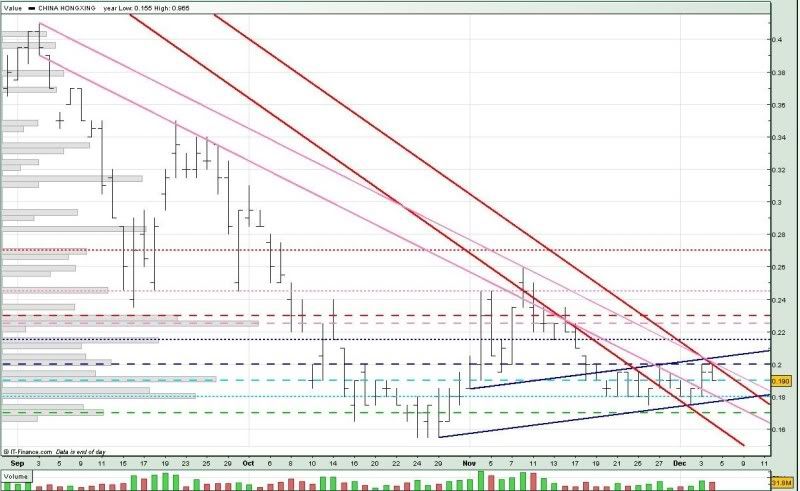
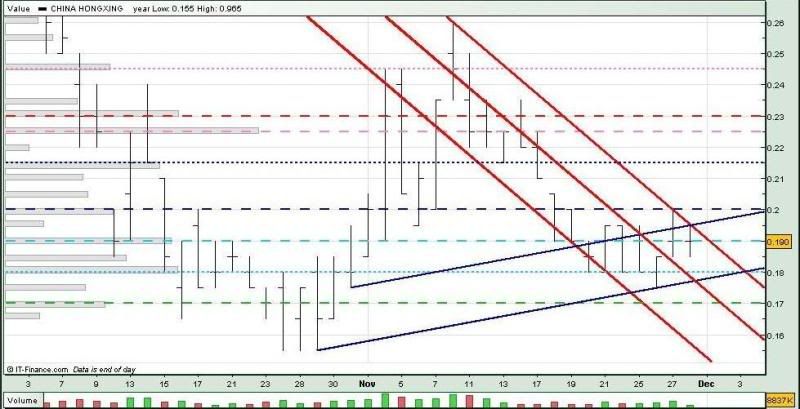
I've updated the long term downtrend channel (red), as well as added a short-term downtrend channel (pink). As you can see from the chart, both of these resistances coincide with the 0.200 resistance neckline (blue --).
Moreover, the long term downtrend resistance (upp red) is also pushing China Hongxing towards the 0.190 support (lightblue --).
We could see some action tomorrow for China Hongxing. If it still fails to break the 0.200 neckline, we could see it revisiting the 0.180 support (lightblue ...).
For tomorrow :
Support @ 0.190 (lightblue --), 0.180 (lightblue ...), 0.177 (low blue, low pink), 0.170 (green --)
Resistance @ 0.195 (upp red), 0.198 (upp pink), 0.200 (blue --), 0.205 (upp blue), 0.215 (blue ...)
Moreover, the long term downtrend resistance (upp red) is also pushing China Hongxing towards the 0.190 support (lightblue --).
We could see some action tomorrow for China Hongxing. If it still fails to break the 0.200 neckline, we could see it revisiting the 0.180 support (lightblue ...).

For tomorrow :
Support @ 0.190 (lightblue --), 0.180 (lightblue ...), 0.177 (low blue, low pink), 0.170 (green --)
Resistance @ 0.195 (upp red), 0.198 (upp pink), 0.200 (blue --), 0.205 (upp blue), 0.215 (blue ...)
STI pulls back as Dow futures fall
by R SIVANITHY (4 Dec)
Straits Times Index sheds early gains in anticipation of Wall Street drop; index propped up by SingTel
So judging by the Straits Times Index's late dive, US stocks were expected to turn in a weak session yesterday. After rising as much as 30 points in the morning to 1,670, the Straits Times Index (STI) ended just 1.39 points up at 1,640.57.
A 150-point loss in the December futures contract on the Dow Jones Industrial Average and Europe opening an average of 2 per cent weaker accounted for the late nervousness, though the broad market clearly did not have time to react to the sell-off in the index - excluding index stocks and warrants, there were still 185 rises versus 120 falls in the rest of the market.
Hong Kong's Hang Seng Index continued to set the pace throughout the day, penny commodity and China stocks continued to soak up what little liquidity there was and as far as the Straits Times Index was concerned, it was almost entirely propped up by SingTel, possibly because it appeared as top pick in Merrill Lynch's 'most preferred' list. SingTel's eight-cent rise to $2.50 added 8.3 points to the STI.
None of this should come as any surprise. For one, anecdotal evidence is that many fund managers have closed their books early for the year and gone on holiday, a major factor behind the poor volume of the past few weeks.
In yesterday's session, a weak one billion units, excluding foreign currency issues, worth $744 million were traded.
Economic news coming out of the US has mainly been negative, with the worst manufacturing number since 1982 released on Monday. The latest jobs report is due on Friday. Analysts too are now increasingly bracing themselves for a weak 2009.
In its Dec 2 Emerging Markets Daily, for instance, Citigroup Global Markets said of Singapore that near-term growth prospects are grim with the economy unlikely to escape a contraction next year.
'The current recession is likely to continue for at least the next two to three quarters with GDP expected to contract in y-o-y terms, at least through 1H09,' said Citi. It said its GDP forecast is well below consensus or government forecasts and added that any uncertainty with forecasts relates to the magnitude rather than the likelihood of a contraction.
UBS Investment Research (UBSIR) issued its 2009 Outlook report yesterday titled Navigating a recession. It said there could be a rally of 15-20 per cent in the first quarter because markets are deeply oversold but its central thesis is for a grim economic outlook and high risk aversion.
UBSIR is expecting 30,000 job losses in 2009 - the worst on record for a single year but less severe than the cumulative 42,000 lost during the Asian financial crisis and the 79,500 lost during the two years when the tech bubble burst and Sars struck.
'We forecast a fair value of 2,100 for the STI at end-2009, assuming 12x trailing PE and a 33 per cent decline in earnings. We see a firmer uptrend mostly at the tail end of 2009 when the worst of the economic conditions are likely to have passed,' said UBSIR.
In a property wrap titled Buy another day, JPMorgan said with financing as uncertain as it is, the fundamental value of properties cannot be reliably determined. It noted that in previous cycles it took 11-13 quarters between peak and trough prices and that if the most recent peak was mid-2007, the next trough should be mid-2010.
-Research Report by R SIVANITHY (4 Dec)
Straits Times Index sheds early gains in anticipation of Wall Street drop; index propped up by SingTel
So judging by the Straits Times Index's late dive, US stocks were expected to turn in a weak session yesterday. After rising as much as 30 points in the morning to 1,670, the Straits Times Index (STI) ended just 1.39 points up at 1,640.57.
A 150-point loss in the December futures contract on the Dow Jones Industrial Average and Europe opening an average of 2 per cent weaker accounted for the late nervousness, though the broad market clearly did not have time to react to the sell-off in the index - excluding index stocks and warrants, there were still 185 rises versus 120 falls in the rest of the market.
Hong Kong's Hang Seng Index continued to set the pace throughout the day, penny commodity and China stocks continued to soak up what little liquidity there was and as far as the Straits Times Index was concerned, it was almost entirely propped up by SingTel, possibly because it appeared as top pick in Merrill Lynch's 'most preferred' list. SingTel's eight-cent rise to $2.50 added 8.3 points to the STI.
None of this should come as any surprise. For one, anecdotal evidence is that many fund managers have closed their books early for the year and gone on holiday, a major factor behind the poor volume of the past few weeks.
In yesterday's session, a weak one billion units, excluding foreign currency issues, worth $744 million were traded.
Economic news coming out of the US has mainly been negative, with the worst manufacturing number since 1982 released on Monday. The latest jobs report is due on Friday. Analysts too are now increasingly bracing themselves for a weak 2009.
In its Dec 2 Emerging Markets Daily, for instance, Citigroup Global Markets said of Singapore that near-term growth prospects are grim with the economy unlikely to escape a contraction next year.
'The current recession is likely to continue for at least the next two to three quarters with GDP expected to contract in y-o-y terms, at least through 1H09,' said Citi. It said its GDP forecast is well below consensus or government forecasts and added that any uncertainty with forecasts relates to the magnitude rather than the likelihood of a contraction.
UBS Investment Research (UBSIR) issued its 2009 Outlook report yesterday titled Navigating a recession. It said there could be a rally of 15-20 per cent in the first quarter because markets are deeply oversold but its central thesis is for a grim economic outlook and high risk aversion.
UBSIR is expecting 30,000 job losses in 2009 - the worst on record for a single year but less severe than the cumulative 42,000 lost during the Asian financial crisis and the 79,500 lost during the two years when the tech bubble burst and Sars struck.
'We forecast a fair value of 2,100 for the STI at end-2009, assuming 12x trailing PE and a 33 per cent decline in earnings. We see a firmer uptrend mostly at the tail end of 2009 when the worst of the economic conditions are likely to have passed,' said UBSIR.
In a property wrap titled Buy another day, JPMorgan said with financing as uncertain as it is, the fundamental value of properties cannot be reliably determined. It noted that in previous cycles it took 11-13 quarters between peak and trough prices and that if the most recent peak was mid-2007, the next trough should be mid-2010.
-Research Report by R SIVANITHY (4 Dec)
Commodities Sector Research Report
by OCBC INVESTMENT RESEARCH (3 Dec)
COMMODITIES have gone through a roller-coaster ride in 2008 and are likely to fall victim to further volatility in 2009 along with the broad market. 2009 presents a challenging macro outlook. Moving into next year, we believe that several macro factors could continue to weigh on the sector's outlook.
These include the shaky global macroeconomic outlook, softening demand from manufacturers and consumers, a prolonged credit drought and falling commodities prices.
While the near-term outlook is likely to remain muted, coordinated government policies could help to stabilise the overall climate in the medium term. For instance, China has recently announced a four trillion yuan (S$888 billion) stimulus package and an interest rate cut to boost the cooling economy. Large-scale spending such as these will help to bolster the demand for commodities such as steel and energy, albeit in the further future.
Commodities have been proven to outperform the stock market in times of crisis. Nevertheless, as demand for commodities is a function of the global economy, we expect the sentiment for these stocks to recover only when macroeconomic pessimism fades. As such, we are NEUTRAL on the sector.
At current valuations, the risk-reward profile of some stocks has grown attractive for long-term investors who are prepared to ride out the volatility.
-Research Report by OCBC INVESTMENT RESEARCH (3 Dec)
COMMODITIES have gone through a roller-coaster ride in 2008 and are likely to fall victim to further volatility in 2009 along with the broad market. 2009 presents a challenging macro outlook. Moving into next year, we believe that several macro factors could continue to weigh on the sector's outlook.
These include the shaky global macroeconomic outlook, softening demand from manufacturers and consumers, a prolonged credit drought and falling commodities prices.
While the near-term outlook is likely to remain muted, coordinated government policies could help to stabilise the overall climate in the medium term. For instance, China has recently announced a four trillion yuan (S$888 billion) stimulus package and an interest rate cut to boost the cooling economy. Large-scale spending such as these will help to bolster the demand for commodities such as steel and energy, albeit in the further future.
Commodities have been proven to outperform the stock market in times of crisis. Nevertheless, as demand for commodities is a function of the global economy, we expect the sentiment for these stocks to recover only when macroeconomic pessimism fades. As such, we are NEUTRAL on the sector.
At current valuations, the risk-reward profile of some stocks has grown attractive for long-term investors who are prepared to ride out the volatility.
-Research Report by OCBC INVESTMENT RESEARCH (3 Dec)
China Milk Research Report
by DMG & PARTNERS SECURITIES (3 Dec)
IN November, the Chinese government overhauled the entire dairy industry to improve safety at every step of the value chain. From cow breeding to the end product that customers consume.
We believe that China Milk is going to benefit from this because they have extremely high quality standards and supervision at every stage of the value chain.
China Milk feeds its herd the best quality feed, which it grows itself. The fertiliser used to grow the animal feed is also from its own herd. This insures that there are no dangerous chemicals being added to the crops. In our view, we believe that the Chinese government should base quality standards using China Milk as an example.
The exposure of many problems existing in quality control and supervision of the industry has dampened China's global reputation. However, we believe that the rebuilding process of its dairy industry will only make China's dairy sector more attractive in the long term.
-Research Report by DMG & PARTNERS SECURITIES (3 Dec)
IN November, the Chinese government overhauled the entire dairy industry to improve safety at every step of the value chain. From cow breeding to the end product that customers consume.
We believe that China Milk is going to benefit from this because they have extremely high quality standards and supervision at every stage of the value chain.
China Milk feeds its herd the best quality feed, which it grows itself. The fertiliser used to grow the animal feed is also from its own herd. This insures that there are no dangerous chemicals being added to the crops. In our view, we believe that the Chinese government should base quality standards using China Milk as an example.
The exposure of many problems existing in quality control and supervision of the industry has dampened China's global reputation. However, we believe that the rebuilding process of its dairy industry will only make China's dairy sector more attractive in the long term.
-Research Report by DMG & PARTNERS SECURITIES (3 Dec)
Wednesday, December 3, 2008
No surprise again as STI reacts to US dive
by R SIVANITHY (3 Dec)
ONCE again, there was no surprise in trading yesterday as Wall Street's already-anticipated - at least in this column - Monday crash reverberated around this part of the world.
With Japan caving in by 6 per cent, Hong Kong's Hang Seng Index losing 5 per cent, Australia 4 per cent and Europe opening an average 1.5 per cent weaker, the Straits Times Index stood little chance, though there was some consolation in the fact that it fell by only 51.05 points or 3 per cent to 1,639.18 and that trading was thin and listless.
Wall Street's loss of almost 9 per cent on Monday should not have surprised anyone, given that its major indices had been clearly window-dressed last week for the November month-end.
Still, news reports attributed the fall to official confirmation from the National Bureau of Economic Research that the US has been in recession for 12 months now, as well as a poor reading for the November Institute for Supply Management's index of manufacturing conditions. The latter figure came in at 36.2, below the consensus of 37, and was the weakest since 1982.
Independent research outfit Ideaglobal said in its Financial Markets Today that 'although the manufacturing landscape has been weak for some time now, this could mark the next leg down for prospects for the sector for months to come as conditions are unlikely to improve any time soon'.
Ideaglobal added the data confirms that domestic US weakness is now complementing deteriorating global conditions and that this should enhance the case for a 50-basis-point interest rate cut at the Dec 16 Federal Open Market Committee meeting.
Brokers attributed the subdued conditions here to the absence of many players either due to the holiday season and/or their losses over the past year, which by now would have reached extreme proportions.
Turnover, excluding foreign currency issues, was a poor 750 million units worth $770 million, with volume concentrated on commodity stocks like Golden Agri, Indofood Agri and Noble Group, and battered China stocks like Yangzijiang, China Hongxing and Cosco Corp.
Virtually the entire list of top 20 rises were structured put warrants on various indices, mainly the Hang Seng. DBS stood out among the banks as the only gainer, while after outperforming on the way up last week, UOB looks to be now doing the same on the way down - it dropped 48 cents on Monday and 70 cents yesterday to end at $12.
Credit Suisse (CS) maintained its 'underweight' on the property sector. In its Asian Daily yesterday, CS said it expects news flows from the sector to remain negative as default/credit risks rise in a recessionary environment. Its bear-case RNAV for CapitaLand is $1.70 and for City Developments is $4.51.
Merrill Lynch, in the meantime, on Monday maintained a 'neutral' view on City Dev with a $5.86 target price, following news that the latter's hotel subsidiary has not been able to sell the Millennium Seoul Hilton in Korea.
CapitaLand yesterday fell 10 cents to $2.49 with 14 million traded, while City Dev lost 13 cents at $5.25 with 2.5 million done.
-Research Report by R SIVANITHY (3 Dec)
ONCE again, there was no surprise in trading yesterday as Wall Street's already-anticipated - at least in this column - Monday crash reverberated around this part of the world.
With Japan caving in by 6 per cent, Hong Kong's Hang Seng Index losing 5 per cent, Australia 4 per cent and Europe opening an average 1.5 per cent weaker, the Straits Times Index stood little chance, though there was some consolation in the fact that it fell by only 51.05 points or 3 per cent to 1,639.18 and that trading was thin and listless.
Wall Street's loss of almost 9 per cent on Monday should not have surprised anyone, given that its major indices had been clearly window-dressed last week for the November month-end.
Still, news reports attributed the fall to official confirmation from the National Bureau of Economic Research that the US has been in recession for 12 months now, as well as a poor reading for the November Institute for Supply Management's index of manufacturing conditions. The latter figure came in at 36.2, below the consensus of 37, and was the weakest since 1982.
Independent research outfit Ideaglobal said in its Financial Markets Today that 'although the manufacturing landscape has been weak for some time now, this could mark the next leg down for prospects for the sector for months to come as conditions are unlikely to improve any time soon'.
Ideaglobal added the data confirms that domestic US weakness is now complementing deteriorating global conditions and that this should enhance the case for a 50-basis-point interest rate cut at the Dec 16 Federal Open Market Committee meeting.
Brokers attributed the subdued conditions here to the absence of many players either due to the holiday season and/or their losses over the past year, which by now would have reached extreme proportions.
Turnover, excluding foreign currency issues, was a poor 750 million units worth $770 million, with volume concentrated on commodity stocks like Golden Agri, Indofood Agri and Noble Group, and battered China stocks like Yangzijiang, China Hongxing and Cosco Corp.
Virtually the entire list of top 20 rises were structured put warrants on various indices, mainly the Hang Seng. DBS stood out among the banks as the only gainer, while after outperforming on the way up last week, UOB looks to be now doing the same on the way down - it dropped 48 cents on Monday and 70 cents yesterday to end at $12.
Credit Suisse (CS) maintained its 'underweight' on the property sector. In its Asian Daily yesterday, CS said it expects news flows from the sector to remain negative as default/credit risks rise in a recessionary environment. Its bear-case RNAV for CapitaLand is $1.70 and for City Developments is $4.51.
Merrill Lynch, in the meantime, on Monday maintained a 'neutral' view on City Dev with a $5.86 target price, following news that the latter's hotel subsidiary has not been able to sell the Millennium Seoul Hilton in Korea.
CapitaLand yesterday fell 10 cents to $2.49 with 14 million traded, while City Dev lost 13 cents at $5.25 with 2.5 million done.
-Research Report by R SIVANITHY (3 Dec)
China Hongx 031208
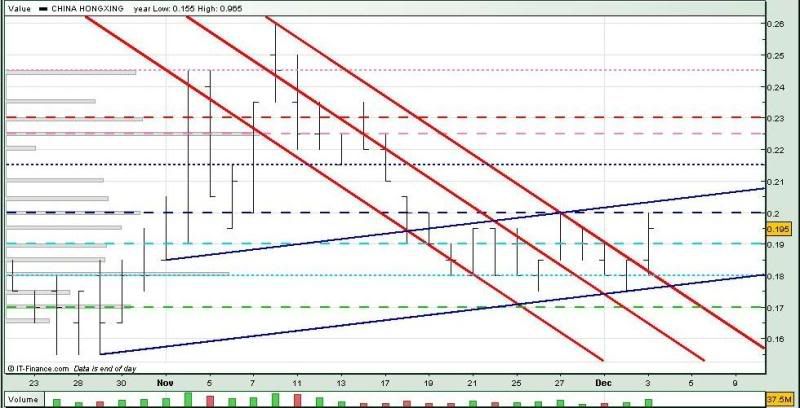
China Hongxing broke the long term downtrend resistance (upp red) today. Although today's volume was more than doubled yesterday's, it is only about half of the volume during China Hongxing's surge during end oct to early nov.
China Hongxing tested the 0.200 neckline (blue --) before ending the day just below it. Only 1 trade of 30 lots was done at 0.200. A total of 12,756 lots (11,599 lots buying up) was done at 0.195, and 21,166 lots done at 0.190 (50% buying up and selling down).
It remains to be seen if China Hongxing can maintain its uptrend momentum and break the 0.200 neckline (blue --). Or we might still continue to see it trading sideways between the 0.180 support and 0.190 neckline, which could still be profitable.
For tomorrow :
Support @ 0.190 (lightblue --), 0.180 (lightblue ...), 0.177 (low blue, upp red), 0.170 (green --)
Resistance @ 0.200 (blue --), 0.205 (upp blue), 0.215 (blue ...)
China Hongxing tested the 0.200 neckline (blue --) before ending the day just below it. Only 1 trade of 30 lots was done at 0.200. A total of 12,756 lots (11,599 lots buying up) was done at 0.195, and 21,166 lots done at 0.190 (50% buying up and selling down).
It remains to be seen if China Hongxing can maintain its uptrend momentum and break the 0.200 neckline (blue --). Or we might still continue to see it trading sideways between the 0.180 support and 0.190 neckline, which could still be profitable.

For tomorrow :
Support @ 0.190 (lightblue --), 0.180 (lightblue ...), 0.177 (low blue, upp red), 0.170 (green --)
Resistance @ 0.200 (blue --), 0.205 (upp blue), 0.215 (blue ...)
Cosco says client cancels order for 2 vessels
SINGAPORE - Cosco Corp said on Wednesday that a customer has scrapped orders for two of five bulk carriers because of unfavourable market conditions.
The Chinese ship building and repair firm will also postpone delivery of the remaining three vessels to June 2010 from December 2009, it said in a filing to the Singapore Exchange. The order was made in July 2007.
Cosco did not disclose the contract value, but a July 2007 statement said the firm had clinched orders for eight 57,000 deadweight tonne bulk carriers worth a total of US$313 million.
As part compensation, the buyer has to pay 80 per cent of the contract price for the remaining three vessels this month.
The buyer will also compensate Cosco Dalian for all expenses incurred for the two cancelled orders, for which construction has not started. -- REUTERS
The Chinese ship building and repair firm will also postpone delivery of the remaining three vessels to June 2010 from December 2009, it said in a filing to the Singapore Exchange. The order was made in July 2007.
Cosco did not disclose the contract value, but a July 2007 statement said the firm had clinched orders for eight 57,000 deadweight tonne bulk carriers worth a total of US$313 million.
As part compensation, the buyer has to pay 80 per cent of the contract price for the remaining three vessels this month.
The buyer will also compensate Cosco Dalian for all expenses incurred for the two cancelled orders, for which construction has not started. -- REUTERS
Tuesday, December 2, 2008
Semb Marine Research Report
by BNP Paribas (2 Dec)
LOWER but not low oil prices: We believe it is reasonable to question the general outlook for the oil industry following the recent news about potential order cancellations at Keppel Corp.
For Sembcorp Marine (SembMarine), we are concerned if the offshore orders would decline drastically and coupled with order cancellations would decimate the order books.
Seadrill, a client of SembMarine, is facing difficulties in getting financing for some of its offshore orders with SembMarine. This is resulting in a potential order cancellation by Seadrill.
Analysis of Seadrill's financials gives us a better picture of the underlying situation. Seadrill's profit & loss and cashflow positions are good, indicating strong underlying business fundamentals. For Q3 2008, net profit increased 211 per cent y-o-y to US$69 million. Operating cashflow stood at US$730 million (up 12 per cent y-o-y).
It was poor corporate finance decisions that led to difficulties. Net gearing in Q3 2008 was 163 per cent, up from 122 per cent q-o-q. There are also other factors working against it - total return swaps, aggressive off-balance sheet financing and large equity investment stakes.
Oil prices have now declined for the fifth month since its high of US$147 per barrel in July 2008 and yet rig utilisation and day rates are still strong. Our positive argument for SembMarine is dependent on the recovery of overall market sentiment and not earnings.
Also, lower oil prices at US$50-60 per barrel are not only sustainable for oil producers, they ensure that costs for most economic activities will be lower in 2009. We believe cost deflation will be the first step in market sentiment recovery.
Lower oil prices will not only keep demand alive but also keep alternative energy out, and make it easier for producers to undertake long-term exploration decisions. This in turn will ensure SembMarine stays sustainably busy.
Valuation presents opportunity; SembMarine continues to trade well below the historical period of 1997-2003. Our TP remains at 12 times 2009 PE. The dividend yield is attractive at levels above 10 per cent.
-Research Report by BNP Paribas (2 Dec)
LOWER but not low oil prices: We believe it is reasonable to question the general outlook for the oil industry following the recent news about potential order cancellations at Keppel Corp.
For Sembcorp Marine (SembMarine), we are concerned if the offshore orders would decline drastically and coupled with order cancellations would decimate the order books.
Seadrill, a client of SembMarine, is facing difficulties in getting financing for some of its offshore orders with SembMarine. This is resulting in a potential order cancellation by Seadrill.
Analysis of Seadrill's financials gives us a better picture of the underlying situation. Seadrill's profit & loss and cashflow positions are good, indicating strong underlying business fundamentals. For Q3 2008, net profit increased 211 per cent y-o-y to US$69 million. Operating cashflow stood at US$730 million (up 12 per cent y-o-y).
It was poor corporate finance decisions that led to difficulties. Net gearing in Q3 2008 was 163 per cent, up from 122 per cent q-o-q. There are also other factors working against it - total return swaps, aggressive off-balance sheet financing and large equity investment stakes.
Oil prices have now declined for the fifth month since its high of US$147 per barrel in July 2008 and yet rig utilisation and day rates are still strong. Our positive argument for SembMarine is dependent on the recovery of overall market sentiment and not earnings.
Also, lower oil prices at US$50-60 per barrel are not only sustainable for oil producers, they ensure that costs for most economic activities will be lower in 2009. We believe cost deflation will be the first step in market sentiment recovery.
Lower oil prices will not only keep demand alive but also keep alternative energy out, and make it easier for producers to undertake long-term exploration decisions. This in turn will ensure SembMarine stays sustainably busy.
Valuation presents opportunity; SembMarine continues to trade well below the historical period of 1997-2003. Our TP remains at 12 times 2009 PE. The dividend yield is attractive at levels above 10 per cent.
-Research Report by BNP Paribas (2 Dec)
No surprise as STI falls in thin volume
by R SIVANITHY (2 Dec)
Index loses 2.4 per cent after last week's late, narrowly focused window-dressing push
PERHAPS not surprisingly, the Straits Times Index (STI) yesterday failed to follow through from last week's late window-dressing push, instead dropping 42.34 points or 2.4 per cent to 1,690.23 in extremely thin trading totalling 945 million units worth $745 million, excluding foreign currency issues.
Commodity stocks soaked up the bulk of what little volume there was, while among blue chips it was banks and property stocks that came under pressure.
The STI last week gained 70 points, in what was most probably an attempt to window-dress the month's performance using the mid-week announcement of a new US$800 billion lifeline by the US Federal Reserve for distressed US consumer debt markets as a launchpad.
However, the push was narrowly focused, centred mainly on index stocks and came with low volume - all of which suggested that it would not last.
This point was made by DMG & Partners in a technical view yesterday, where it said that although the index rose last week, any upside this week is expected to be short-lived.
'The mini-rally currently in play has not been accompanied by a significant increase in trading volume, an indication that buying momentum is not strong,' said the broker.
DMG noted that selling pressure would also probably be similarly contained because of low volume and set resistance at 1,760-1,770 and support at 1,570-1,580.
All three banks closed weaker, led by last week's top performer UOB which dropped 48 cents or 3.6 per cent to $12.70 with three million shares traded.
In a Nov 28 report on the sector, Macquarie Research said these are its operational expectations for the sector going forward: margins are expected to contract mildly, loan growth momentum to slow, non-interest income to soften on weak capital market conditions, and asset quality to progressively deteriorate.
Notwithstanding these, Macquarie recommended an 'overweight' on all three, with DBS and OCBC the top picks.
In the property sector, City Developments' (City Dev) 40-cent or 7 per cent plunge to $5.38 stood out after news that its hotel subsidiary M&C has been unable to finalise the sale of Millennium Seoul Hilton. In a 'hold' on City Dev, Deutsche Bank yesterday said this is negative for sentiment but there would be no impact on earnings.
In its 2009 Asia Pacific Portfolio Strategy dated Nov 29 and titled '2009 Outlook: Many rivers to cross', Goldman Sachs said investors should brace themselves for more risk than return.
'The investment outlook for Asian equities is probably one of low returns overall but with wide ranges ... the bottom line is that we think risks to growth remain on the downside notwithstanding countervailing policy actions. In turn, this is likely to increase the risks to corporate earnings and may keep valuations low.'
It added 'there are sufficient reasons to examine the possibility that the global downturn will be more prolonged than currently expected. These include a) negative momentum of consensus forecasts, b) the size of the debt burden in the US and c) the de-leveraging experiences of Japan and Sweden in the 1990s'.
Goldman also said it expects 15-35 per cent earnings declines in Asia for 2009 versus consensus of 5 per cent growth and that existing forecasts are unduly optimistic. China is its only 'overweight'; Korea, Taiwan and Australia were downgraded to 'underweight'; while Hong Kong and Singapore were classed as 'market weight'.
-Research Report by R SIVANITHY (2 Dec)
Index loses 2.4 per cent after last week's late, narrowly focused window-dressing push
PERHAPS not surprisingly, the Straits Times Index (STI) yesterday failed to follow through from last week's late window-dressing push, instead dropping 42.34 points or 2.4 per cent to 1,690.23 in extremely thin trading totalling 945 million units worth $745 million, excluding foreign currency issues.
Commodity stocks soaked up the bulk of what little volume there was, while among blue chips it was banks and property stocks that came under pressure.
The STI last week gained 70 points, in what was most probably an attempt to window-dress the month's performance using the mid-week announcement of a new US$800 billion lifeline by the US Federal Reserve for distressed US consumer debt markets as a launchpad.
However, the push was narrowly focused, centred mainly on index stocks and came with low volume - all of which suggested that it would not last.
This point was made by DMG & Partners in a technical view yesterday, where it said that although the index rose last week, any upside this week is expected to be short-lived.
'The mini-rally currently in play has not been accompanied by a significant increase in trading volume, an indication that buying momentum is not strong,' said the broker.
DMG noted that selling pressure would also probably be similarly contained because of low volume and set resistance at 1,760-1,770 and support at 1,570-1,580.
All three banks closed weaker, led by last week's top performer UOB which dropped 48 cents or 3.6 per cent to $12.70 with three million shares traded.
In a Nov 28 report on the sector, Macquarie Research said these are its operational expectations for the sector going forward: margins are expected to contract mildly, loan growth momentum to slow, non-interest income to soften on weak capital market conditions, and asset quality to progressively deteriorate.
Notwithstanding these, Macquarie recommended an 'overweight' on all three, with DBS and OCBC the top picks.
In the property sector, City Developments' (City Dev) 40-cent or 7 per cent plunge to $5.38 stood out after news that its hotel subsidiary M&C has been unable to finalise the sale of Millennium Seoul Hilton. In a 'hold' on City Dev, Deutsche Bank yesterday said this is negative for sentiment but there would be no impact on earnings.
In its 2009 Asia Pacific Portfolio Strategy dated Nov 29 and titled '2009 Outlook: Many rivers to cross', Goldman Sachs said investors should brace themselves for more risk than return.
'The investment outlook for Asian equities is probably one of low returns overall but with wide ranges ... the bottom line is that we think risks to growth remain on the downside notwithstanding countervailing policy actions. In turn, this is likely to increase the risks to corporate earnings and may keep valuations low.'
It added 'there are sufficient reasons to examine the possibility that the global downturn will be more prolonged than currently expected. These include a) negative momentum of consensus forecasts, b) the size of the debt burden in the US and c) the de-leveraging experiences of Japan and Sweden in the 1990s'.
Goldman also said it expects 15-35 per cent earnings declines in Asia for 2009 versus consensus of 5 per cent growth and that existing forecasts are unduly optimistic. China is its only 'overweight'; Korea, Taiwan and Australia were downgraded to 'underweight'; while Hong Kong and Singapore were classed as 'market weight'.
-Research Report by R SIVANITHY (2 Dec)
Sunday, November 30, 2008
Be careful of buying into yet another bear rally
by R SIVANITHY (30 Nov)
SINGAPORE - Once the month-end window-dressing of the major indices seen last week is over with (probably early this week), it's very likely that Wall Street and markets in this part of the world will revert back to reacting to the dismal economic and earnings news that's being issued, news that's not expected to be good.
On Monday for example, the US market will have to ponder the release of the November Institute of Supply Management (ISM) manufacturing report. Independent research firm Ideaglobal over the weekend had this to say about the report: 'We expect the headline measure will continue pushing lower in Nov to 38, declining from 38.9 seen in Oct.'
'The manufacturing sector has seen consistently weak results thus far in 2008...thus far in Oct, the headline measures for both New York and Philadelphia painted a very grim picture for manufacturing in the coming months...overall, the lack of new domestic business activity will continue to overshadow declining external demand for US goods and services throughout the remainder of 2008 and into 2009.'
It also added that the US Treasury bond market has fully priced in a deep contraction in Q4 GDP and a very weak start to 2009.
Investors should not forget the not-insignificant problems faced by the US auto industry and the very real likelihood of Detroit, like Iceland a couple of months ago, going bankrupt.
In addition, the US housing market shows no signs of recovery and could in fact be worsening.
Alan Abelson of US newspaper Barron's reports in the Nov 24 issue that the latest victim is commercial real estate.
'The cost of buying protection against default of commercial-mortgage-backed securities has shot up in a notable hurry. The index that tracks such things has more than doubled since (Treasury) Secretary Paulson changed gears on the use of TARP (the US$700b Toxic Assets Rescue Plan that was scrapped recently)', wrote Mr Abelson.
'The yield on such paper with the highest credit rating is now a startling 12 percentage points above the yield on Treasury securities of comparable maturity.'
Our guess is that the Wall Street's bounce last week, supposedly in response to news that the Federal Reserve is to provide an US$800b lifeline for consumer debt was most probably mainly short-covering-induced, aided by a desperate attempt to window-dress the performance of a dismal month and/or year so far.
This process has been also assisted by 'buy' calls from some quarters on the basis that 'markets are oversold' (which in itself is no reason to buy when you really think about it if there are no earnings to speak of) and that all-time laughable classic, 'Asia is decoupled from the US and Europe's problems', which is a hackneyed soundbite trotted out every few years by a financial community that got it spectacularly wrong in 2008 and which can easily be consigned to the scrapheap by pointing out that throughout 2008, Asia has performed much worse than the US or Europe.
Looking further ahead into 2009 though, and you'd have to admit that with the Fed about to run its printing presses at full tilt, the sheer weight of US dollars being printed and thrown at the problem must sooner or later reflate the economy.
As an interesting side issue, it's worth noting that if the Fed were a commercial lender, it would be bankrupt by now. Elsewhere in Barron's Nov 24 issue it is reported that the Fed's capital adequacy ratio is now under 2 per cent, the threshold considered dangerously low.
As former president of the Cleveland Fed Lee Hoskins is quoted saying 'The Fed has violated two principal tenets of central banking - don't lend to insolvent institutions and don't lend on anything but the most pristine collateral'.
Our guess is that any recovery though, if it occurs, will only appear in late 2009 at the earliest. Until then, there will be the odd bear rally to provide some solace for battered bulls, bear rallies like the one seen last week. Investors should tread carefully or risk being caught in yet another bear trap.
-Research Report by R SIVANITHY (30 Nov)
SINGAPORE - Once the month-end window-dressing of the major indices seen last week is over with (probably early this week), it's very likely that Wall Street and markets in this part of the world will revert back to reacting to the dismal economic and earnings news that's being issued, news that's not expected to be good.
On Monday for example, the US market will have to ponder the release of the November Institute of Supply Management (ISM) manufacturing report. Independent research firm Ideaglobal over the weekend had this to say about the report: 'We expect the headline measure will continue pushing lower in Nov to 38, declining from 38.9 seen in Oct.'
'The manufacturing sector has seen consistently weak results thus far in 2008...thus far in Oct, the headline measures for both New York and Philadelphia painted a very grim picture for manufacturing in the coming months...overall, the lack of new domestic business activity will continue to overshadow declining external demand for US goods and services throughout the remainder of 2008 and into 2009.'
It also added that the US Treasury bond market has fully priced in a deep contraction in Q4 GDP and a very weak start to 2009.
Investors should not forget the not-insignificant problems faced by the US auto industry and the very real likelihood of Detroit, like Iceland a couple of months ago, going bankrupt.
In addition, the US housing market shows no signs of recovery and could in fact be worsening.
Alan Abelson of US newspaper Barron's reports in the Nov 24 issue that the latest victim is commercial real estate.
'The cost of buying protection against default of commercial-mortgage-backed securities has shot up in a notable hurry. The index that tracks such things has more than doubled since (Treasury) Secretary Paulson changed gears on the use of TARP (the US$700b Toxic Assets Rescue Plan that was scrapped recently)', wrote Mr Abelson.
'The yield on such paper with the highest credit rating is now a startling 12 percentage points above the yield on Treasury securities of comparable maturity.'
Our guess is that the Wall Street's bounce last week, supposedly in response to news that the Federal Reserve is to provide an US$800b lifeline for consumer debt was most probably mainly short-covering-induced, aided by a desperate attempt to window-dress the performance of a dismal month and/or year so far.
This process has been also assisted by 'buy' calls from some quarters on the basis that 'markets are oversold' (which in itself is no reason to buy when you really think about it if there are no earnings to speak of) and that all-time laughable classic, 'Asia is decoupled from the US and Europe's problems', which is a hackneyed soundbite trotted out every few years by a financial community that got it spectacularly wrong in 2008 and which can easily be consigned to the scrapheap by pointing out that throughout 2008, Asia has performed much worse than the US or Europe.
Looking further ahead into 2009 though, and you'd have to admit that with the Fed about to run its printing presses at full tilt, the sheer weight of US dollars being printed and thrown at the problem must sooner or later reflate the economy.
As an interesting side issue, it's worth noting that if the Fed were a commercial lender, it would be bankrupt by now. Elsewhere in Barron's Nov 24 issue it is reported that the Fed's capital adequacy ratio is now under 2 per cent, the threshold considered dangerously low.
As former president of the Cleveland Fed Lee Hoskins is quoted saying 'The Fed has violated two principal tenets of central banking - don't lend to insolvent institutions and don't lend on anything but the most pristine collateral'.
Our guess is that any recovery though, if it occurs, will only appear in late 2009 at the earliest. Until then, there will be the odd bear rally to provide some solace for battered bulls, bear rallies like the one seen last week. Investors should tread carefully or risk being caught in yet another bear trap.
-Research Report by R SIVANITHY (30 Nov)
Noble Group 281108
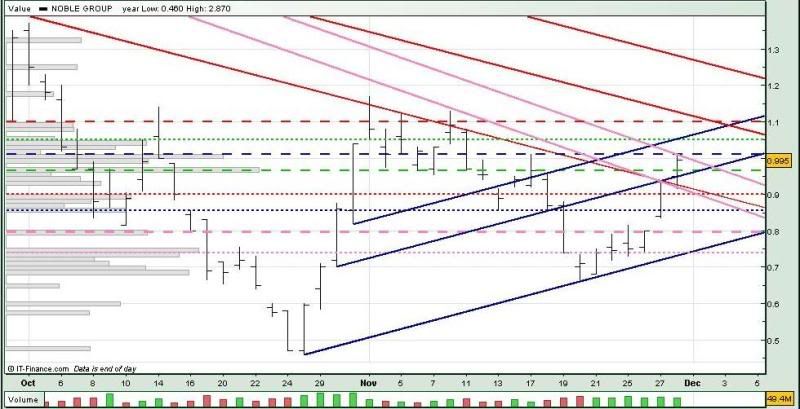
Noble Group has been on the rise since hitting a low of 0.660 on 20 nov. It has also broken the long term downtrend resistance (low red) today, testing the 1.01 resistance (blue --) too.
Has Noble Group formed a double bottom? By the looks of things at them moment, I'd be tempted to say yes. But knowing the erratic and often unpredictable trading patters of Noble Group, we would have to at least wait until Noble Group breaks the 1.10 neckline (red --) before we can safely say it has formed a double bottom.
We could see some profit taking (not forgetting it has been on the rise for the last 6 days), with Noble Group trading between the 1.01 resistance (blue --) and 0.900 support (red ...).
For monday :
Support @ 0.965 (mid blue, green --), 0.915 (low red), 0.900 (low pink, red ...), 0.855 (blue ...), 0.795 (pink --), 0.740 (low blue, pink ...)
Resistance @ 0.995 (upp pink), 1.01 (blue --), 1.05 (green ...), 1.065 (upp blue), 1.10 (red --), 1.115 (mid red)
Has Noble Group formed a double bottom? By the looks of things at them moment, I'd be tempted to say yes. But knowing the erratic and often unpredictable trading patters of Noble Group, we would have to at least wait until Noble Group breaks the 1.10 neckline (red --) before we can safely say it has formed a double bottom.
We could see some profit taking (not forgetting it has been on the rise for the last 6 days), with Noble Group trading between the 1.01 resistance (blue --) and 0.900 support (red ...).

For monday :
Support @ 0.965 (mid blue, green --), 0.915 (low red), 0.900 (low pink, red ...), 0.855 (blue ...), 0.795 (pink --), 0.740 (low blue, pink ...)
Resistance @ 0.995 (upp pink), 1.01 (blue --), 1.05 (green ...), 1.065 (upp blue), 1.10 (red --), 1.115 (mid red)
Indofood Agri 281108
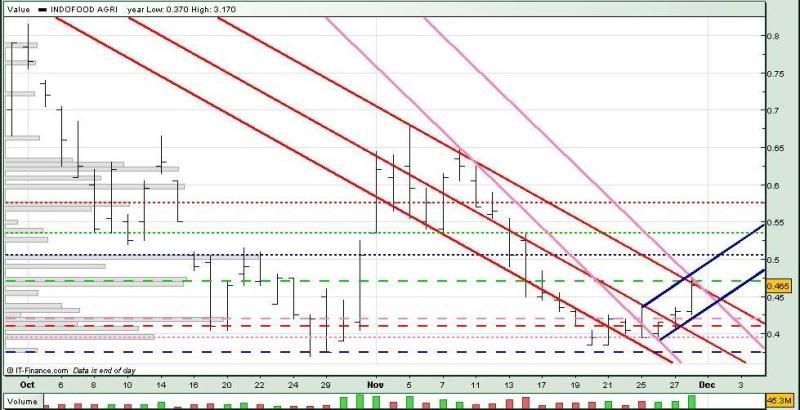
Is Indofood Agri trying to form a triple bottom? (1st bottom was on 18 sep) Indofood Agri recovered from a low of 0.390 on 26 nov, to test the 0.470 neckline (green --) today. It remains to be seen if Indofood Agri can successfully break this neckline this week.
If not, we could be looking at Indofood Agri trading between the 0.470 neckline (green --) and 0.420 support (pink --).
For monday :
Support @ 0.455 (upp pink, upp red), 0.435 (low blue), 0.420 (pink --), 0.410 (red --), 0.395 (pink ...), 0.390 (mid red)
Resistance @ 0.470 (green --), 0.495 (upp blue), 0.505 (blue ...), 0.535 (green ...), 0.575 (red ...)
If not, we could be looking at Indofood Agri trading between the 0.470 neckline (green --) and 0.420 support (pink --).

For monday :
Support @ 0.455 (upp pink, upp red), 0.435 (low blue), 0.420 (pink --), 0.410 (red --), 0.395 (pink ...), 0.390 (mid red)
Resistance @ 0.470 (green --), 0.495 (upp blue), 0.505 (blue ...), 0.535 (green ...), 0.575 (red ...)
China Hongx 281108
Two days on Doji for China Hongxing, and it's being pushed further into a corner formed by the long term downtrend resistance (upp red) and uptrend support (low blue). So we might see some action for China Hongxing this week.
If China Hongxing continues to trade within the downtrend channel (red), we could see it testing the 0.170 support (green --).
For monday :
Support @ 0.190 (lightblue --), 0.180 (lightblue ...), 0.178 (low blue), 0.173 (mid red), 0.170 (green --)
Resistance @ 0.190 (upp red, lightblue --), 0.196 (upp blue), 0.200 (blue --), 0.215 (blue ...)
If China Hongxing continues to trade within the downtrend channel (red), we could see it testing the 0.170 support (green --).

For monday :
Support @ 0.190 (lightblue --), 0.180 (lightblue ...), 0.178 (low blue), 0.173 (mid red), 0.170 (green --)
Resistance @ 0.190 (upp red, lightblue --), 0.196 (upp blue), 0.200 (blue --), 0.215 (blue ...)
Saturday, November 29, 2008
A week spent tracking Wall Street, Citigroup
by R SIVANITHY (29 Nov)
A WEEK spent anticipating how Wall Street might perform later each day as well as wondering what Citigroup's fate might be. These in a nutshell are the major themes of the week just past, the other being that prices here may actually tend to lead Wall Street, rendering the Straits Times Index as possibly a better indicator of how the US market might move than even the US futures market.
Underpinning sentiment was mid-week news that the US Federal Reserve, which can basically print money if it sees fit, will extend a US$800 billion lifeline to distressed consumer debt markets to try and shore up the economy, and that the US government will essentially bail out Citigroup.
So far, Wall Street appears determined to take this as good news with its major indices responding positively, though it has to be stressed that bear rallies can appear deceivingly strong as many have turned out to be this year and there is no reason to expect this time to be any different.
Here, the Straits Times Index firmed by 70 points or 4.2 per cent over the course of the week to 1,732.57 with yesterday's session contributing 22.05 points.
Much of yesterday's gain could be attributed to month-end - and for some fund managers possibly even year-end - window dressing, while the same can possibly be said of markets everywhere.
All three banks benefited from this propping-up exercise, though DBS, despite being pushed up by 33 cents yesterday, still lost a nett 20 cents over the week at $9.40.
In a Thursday overview on Asia-Pacific banks, Merrill Lynch said it is cautious on Singapore banks because of potential negatives such as 1) slowing loan growth 2) a drop in market-related fees and 3) a cyclical rise in credit costs, all of which could depress 2009 earnings.
'The sector trades at mid-cycle valuations - 1.4x book - but that is not 'cheap' in our view given we are entering a down cycle,' said ML. It rates DBS and OCBC as 'underperform' and UOB as 'neutral'.
Keppel Corp, however, yesterday collapsed 60 cents or 12.5 per cent to $4.20 with 27 million shares traded following news that its customers are reviewing their options for $1.2 billion worth of orders.Possibly also a factor was a Wednesday downgrade by Merrill Lynch, which cited concerns about Keppel's exposure to property, oil refining and telecoms.
In a Thursday update, ML said although the impact on earnings is minimal, the news is likely to put a dent on investor confidence in the security of Keppel's current order book. 'If the sector experiences a deep and prolonged slowdown, (Thursday's) announcement is likely to be a sign of future order cancellations,' said ML. For the week, Keppel lost a nett 40 cents or 8.7 per cent.
In his weekly roundup, AMP Capital's head of investment strategy Shane Oliver, said 'while all the activity by governments around the world to get their financial markets working again and stimulate their economies won't head off the recession which is already in train, it does provide confidence that there will be an eventual economic recovery . . . While it's too early to say whether the bear market is over, there is still a good chance shares will rally into year end.'
-Research Report by R SIVANITHY (29 Nov)
A WEEK spent anticipating how Wall Street might perform later each day as well as wondering what Citigroup's fate might be. These in a nutshell are the major themes of the week just past, the other being that prices here may actually tend to lead Wall Street, rendering the Straits Times Index as possibly a better indicator of how the US market might move than even the US futures market.
Underpinning sentiment was mid-week news that the US Federal Reserve, which can basically print money if it sees fit, will extend a US$800 billion lifeline to distressed consumer debt markets to try and shore up the economy, and that the US government will essentially bail out Citigroup.
So far, Wall Street appears determined to take this as good news with its major indices responding positively, though it has to be stressed that bear rallies can appear deceivingly strong as many have turned out to be this year and there is no reason to expect this time to be any different.
Here, the Straits Times Index firmed by 70 points or 4.2 per cent over the course of the week to 1,732.57 with yesterday's session contributing 22.05 points.
Much of yesterday's gain could be attributed to month-end - and for some fund managers possibly even year-end - window dressing, while the same can possibly be said of markets everywhere.
All three banks benefited from this propping-up exercise, though DBS, despite being pushed up by 33 cents yesterday, still lost a nett 20 cents over the week at $9.40.
In a Thursday overview on Asia-Pacific banks, Merrill Lynch said it is cautious on Singapore banks because of potential negatives such as 1) slowing loan growth 2) a drop in market-related fees and 3) a cyclical rise in credit costs, all of which could depress 2009 earnings.
'The sector trades at mid-cycle valuations - 1.4x book - but that is not 'cheap' in our view given we are entering a down cycle,' said ML. It rates DBS and OCBC as 'underperform' and UOB as 'neutral'.
Keppel Corp, however, yesterday collapsed 60 cents or 12.5 per cent to $4.20 with 27 million shares traded following news that its customers are reviewing their options for $1.2 billion worth of orders.Possibly also a factor was a Wednesday downgrade by Merrill Lynch, which cited concerns about Keppel's exposure to property, oil refining and telecoms.
In a Thursday update, ML said although the impact on earnings is minimal, the news is likely to put a dent on investor confidence in the security of Keppel's current order book. 'If the sector experiences a deep and prolonged slowdown, (Thursday's) announcement is likely to be a sign of future order cancellations,' said ML. For the week, Keppel lost a nett 40 cents or 8.7 per cent.
In his weekly roundup, AMP Capital's head of investment strategy Shane Oliver, said 'while all the activity by governments around the world to get their financial markets working again and stimulate their economies won't head off the recession which is already in train, it does provide confidence that there will be an eventual economic recovery . . . While it's too early to say whether the bear market is over, there is still a good chance shares will rally into year end.'
-Research Report by R SIVANITHY (29 Nov)
Quiet session ahead of Wall St closure
by R SIVANITHY (28 Nov)
Local stocks likely sold on event after having been bought in anticipation of US Wednesday rally
THERE are two features of interest associated with yesterday's 0.61- point drop in the Straits Times Index (STI) to 1,710.52. First, the strong likelihood that investors 'bought in anticipation and sold on news' - on Wednesday, the Straits Times Index jumped almost 60 points, of which 40 came in the final few minutes because of sudden expectations that Wall Street would rally that day.
Because a rally did materialise and possibly because the US market is closed on Thursday for Thanksgiving, this then provided the cue to sell, with the STI falling at one point almost 20 points into negative territory.
Second, the fact that Wall Street rose on Wednesday as expected confirms a long-held view expressed in this column that program trading targets this part of the world ahead of the US - the correlation between movements in the STI and the Dow Jones Industrial Average on any given day has been near-perfect for several months now.
Whether this is thanks to synchronised short-covering or whether the STI is singled out for special treatment because of the ease with which it can be manipulated are matters for conjecture; suffice to say that there can be little doubt that as an advance indicator of how US stocks might perform later on any day, the STI's movements are possibly an even better indicator than the US futures market.
Turnover continued to hover below the $1 billion mark, a threshold loosely defined as signifying thin trading. Excluding foreign currency issues, 1.1 billion units worth $952 million were done, the low unit value suggesting penny stocks were more in demand than the larger-cap blue chips.
Among the actives was China shipyard Cosco Corp, a company that could do no wrong last year but one that has fallen on tough times lately.
In downgrading Cosco to 'underperform', Merrill Lynch (ML) in a Nov 26 report said the outlook for order cancellations combined with a sharp drop in the Baltic Dry Index are now painting a more negative outlook for the shipping industry than previously anticipated.
'We cut Cosco's order book by 25 per cent to account for potential order cancellations, reduce our order wins assumptions and reduce our freight rates ... and reduce our price objective to 55 cents a share. We have also cut our FY08-10 earnings estimates by an average of 25 per cent,' said ML.
Cosco yesterday was unchanged at 71.5 cents with 25 million shares traded.
The US investment bank also downgraded Keppel Corp from 'buy' to 'neutral'. In a Nov 26 report, it said the risks associated with Keppel's subsidiary and associate earnings will continue to be a drag on its shares.
'ML Singapore property analysts are not ready to call the bottom for property stocks as the economic outlook remains depressed. Valuation metrics are extremely volatile as the economic climate continues to deteriorate, while we see no catalyst to sustain a re-rating in stock prices,' said ML. Keppel yesterday rose six cents to $4.80 with 8.2 million units done.
In its latest assessment of US economic data, Ideaglobal said there have been signs of weakness for some time but recent events in financial markets have made a bad situation significantly worse.
'At this point, there is no debating whether or not we are in a recession, it has now transformed into a question of how deep and painful it will become,' said Ideaglobal.
-Research Report by R SIVANITHY (28 Nov)
Local stocks likely sold on event after having been bought in anticipation of US Wednesday rally
THERE are two features of interest associated with yesterday's 0.61- point drop in the Straits Times Index (STI) to 1,710.52. First, the strong likelihood that investors 'bought in anticipation and sold on news' - on Wednesday, the Straits Times Index jumped almost 60 points, of which 40 came in the final few minutes because of sudden expectations that Wall Street would rally that day.
Because a rally did materialise and possibly because the US market is closed on Thursday for Thanksgiving, this then provided the cue to sell, with the STI falling at one point almost 20 points into negative territory.
Second, the fact that Wall Street rose on Wednesday as expected confirms a long-held view expressed in this column that program trading targets this part of the world ahead of the US - the correlation between movements in the STI and the Dow Jones Industrial Average on any given day has been near-perfect for several months now.
Whether this is thanks to synchronised short-covering or whether the STI is singled out for special treatment because of the ease with which it can be manipulated are matters for conjecture; suffice to say that there can be little doubt that as an advance indicator of how US stocks might perform later on any day, the STI's movements are possibly an even better indicator than the US futures market.
Turnover continued to hover below the $1 billion mark, a threshold loosely defined as signifying thin trading. Excluding foreign currency issues, 1.1 billion units worth $952 million were done, the low unit value suggesting penny stocks were more in demand than the larger-cap blue chips.
Among the actives was China shipyard Cosco Corp, a company that could do no wrong last year but one that has fallen on tough times lately.
In downgrading Cosco to 'underperform', Merrill Lynch (ML) in a Nov 26 report said the outlook for order cancellations combined with a sharp drop in the Baltic Dry Index are now painting a more negative outlook for the shipping industry than previously anticipated.
'We cut Cosco's order book by 25 per cent to account for potential order cancellations, reduce our order wins assumptions and reduce our freight rates ... and reduce our price objective to 55 cents a share. We have also cut our FY08-10 earnings estimates by an average of 25 per cent,' said ML.
Cosco yesterday was unchanged at 71.5 cents with 25 million shares traded.
The US investment bank also downgraded Keppel Corp from 'buy' to 'neutral'. In a Nov 26 report, it said the risks associated with Keppel's subsidiary and associate earnings will continue to be a drag on its shares.
'ML Singapore property analysts are not ready to call the bottom for property stocks as the economic outlook remains depressed. Valuation metrics are extremely volatile as the economic climate continues to deteriorate, while we see no catalyst to sustain a re-rating in stock prices,' said ML. Keppel yesterday rose six cents to $4.80 with 8.2 million units done.
In its latest assessment of US economic data, Ideaglobal said there have been signs of weakness for some time but recent events in financial markets have made a bad situation significantly worse.
'At this point, there is no debating whether or not we are in a recession, it has now transformed into a question of how deep and painful it will become,' said Ideaglobal.
-Research Report by R SIVANITHY (28 Nov)
Thursday, November 27, 2008
Late surge in anticipation of US rally
by R SIVANITHY (27 Nov)
ST Index closes 58 points higher, but broad market shows only 159 rises versus 137 falls
JUDGING by the Straits Times Index's (STI) 57.88- point rise to 1,711.13 yesterday - the bulk of which came in the final five minutes - program traders were positioning themselves for an expected Wall Street rally later in the day.
The broad market, however, did not fare as well as the index. Excluding STI components and warrants, there were only 159 rises versus 137 falls in the wider market.
The STI owed much of its last-minute gain to a 16-cent rise in SingTel that accounted for 17 points. Of this, 10 cents came in the post-closing adjustment period between 5-5.05pm.
Brokers continued to speak of caution among clients and this was reflected in low volume. Excluding foreign currency issues, only 864 million units worth $931 million were traded.
Among banks, DBS first fell to $9.01 but ended unchanged at $9.20, while UOB's 70-cent jump to $12.60 added 11 points to the index. Brokers speculated that investors were switching from one to the other, possibly because of fears that DBS might call for a rights issue, worries that have arisen because Standard Chartered Bank recently announced a rights issue.
In the second line, Jade Technologies' shares, which cost 30 cents this time last year, closed half a cent lower at 1.5 cents. The company on Tuesday reported a $39 million loss for the full year ended Sept 30. At 1.5 cents a share, Jade's market capitalisation is about $17 million.
Most trading activity was focused on battered commodity plays like Golden Agri, Indofood Agri and Olam International, as well as China stocks that have collapsed significantly from their highs such as China Hongxing, Cosco and Yanlord.
Elsewhere, Bright World's shares lost three cents to 24.5 cents after news that the Monetary Authority of Singapore has written to the company about a possible breach of the Securities and Futures Act.
In a report on the telco sector, OCBC Investment Research said: 'Going into 2009, the whole stock market will continue to face many challenges, most of them coming from the macroeconomic front.
In such a highly unpredictable climate, we believe that a flight to quality is not enough - investors should also focus on defensiveness of earnings as well as sustainable dividend payout abilities and Singapore's telcos meet these criteria. As such, we continue to maintain our 'overweight' rating on the sector.
'While earnings are expected to take a slight knock next year due to the recession, we do not expect the slowdown to have much of an impact, if any, on the telcos' healthy operating cashflows. If anything, we expect more prudent capex spending and other cost-reduction measures to further improve operating cashflows and, in turn, sustain the already attractive dividend policies.'
In its 2009 Outlook report, ratings agency Standard & Poor's (S&P) said that for Asia-Pacific equity markets, a rebound is likely in 2009.
Its director of research Lorraine Tan believes markets are in the process of bottoming. 'Although the economic and corporate news is likely to remain negative - and uncertainty still pervades the global financial system - we see that markets will have retraced in line with, and in some cases exceeded, movements in previous bear markets in terms of both value and time frame,' said Ms Tan.
S&P also said 'ongoing market dislocation will significantly impact Asia-Pacific in 2009, but factors such as intra-regional trade, supportive policy-making, and still-robust forecasts for China and India will help the region navigate the global storm'.
-Research Report by R SIVANITHY (27 Nov)
ST Index closes 58 points higher, but broad market shows only 159 rises versus 137 falls
JUDGING by the Straits Times Index's (STI) 57.88- point rise to 1,711.13 yesterday - the bulk of which came in the final five minutes - program traders were positioning themselves for an expected Wall Street rally later in the day.
The broad market, however, did not fare as well as the index. Excluding STI components and warrants, there were only 159 rises versus 137 falls in the wider market.
The STI owed much of its last-minute gain to a 16-cent rise in SingTel that accounted for 17 points. Of this, 10 cents came in the post-closing adjustment period between 5-5.05pm.
Brokers continued to speak of caution among clients and this was reflected in low volume. Excluding foreign currency issues, only 864 million units worth $931 million were traded.
Among banks, DBS first fell to $9.01 but ended unchanged at $9.20, while UOB's 70-cent jump to $12.60 added 11 points to the index. Brokers speculated that investors were switching from one to the other, possibly because of fears that DBS might call for a rights issue, worries that have arisen because Standard Chartered Bank recently announced a rights issue.
In the second line, Jade Technologies' shares, which cost 30 cents this time last year, closed half a cent lower at 1.5 cents. The company on Tuesday reported a $39 million loss for the full year ended Sept 30. At 1.5 cents a share, Jade's market capitalisation is about $17 million.
Most trading activity was focused on battered commodity plays like Golden Agri, Indofood Agri and Olam International, as well as China stocks that have collapsed significantly from their highs such as China Hongxing, Cosco and Yanlord.
Elsewhere, Bright World's shares lost three cents to 24.5 cents after news that the Monetary Authority of Singapore has written to the company about a possible breach of the Securities and Futures Act.
In a report on the telco sector, OCBC Investment Research said: 'Going into 2009, the whole stock market will continue to face many challenges, most of them coming from the macroeconomic front.
In such a highly unpredictable climate, we believe that a flight to quality is not enough - investors should also focus on defensiveness of earnings as well as sustainable dividend payout abilities and Singapore's telcos meet these criteria. As such, we continue to maintain our 'overweight' rating on the sector.
'While earnings are expected to take a slight knock next year due to the recession, we do not expect the slowdown to have much of an impact, if any, on the telcos' healthy operating cashflows. If anything, we expect more prudent capex spending and other cost-reduction measures to further improve operating cashflows and, in turn, sustain the already attractive dividend policies.'
In its 2009 Outlook report, ratings agency Standard & Poor's (S&P) said that for Asia-Pacific equity markets, a rebound is likely in 2009.
Its director of research Lorraine Tan believes markets are in the process of bottoming. 'Although the economic and corporate news is likely to remain negative - and uncertainty still pervades the global financial system - we see that markets will have retraced in line with, and in some cases exceeded, movements in previous bear markets in terms of both value and time frame,' said Ms Tan.
S&P also said 'ongoing market dislocation will significantly impact Asia-Pacific in 2009, but factors such as intra-regional trade, supportive policy-making, and still-robust forecasts for China and India will help the region navigate the global storm'.
-Research Report by R SIVANITHY (27 Nov)
Wednesday, November 26, 2008
Investors continue to sell into strength
by R SIVANITHY (26 Nov)
SELLING into strength has been the preferred strategy over the past year and so it was again yesterday - the Straits Times Index first shot up 70 points in response to Monday's Wall Street rally but eventually closed just 32.96 points up at 1,653.25. It stood at 1,640 at 5pm but gained about 12 points in the post-closing adjustment period, mainly through a last-minute push on DBS and Keppel Corp.
The broad market was much more mixed than the index's reading would suggest - excluding foreign currency stocks, warrants and STI components, there were only 150 rises versus 148 falls.
Talk to dealers and the picture they would paint about the state of the local stock market remains the same as it has been for months now - stocks remain trapped within narrow bands with rallies viewed as bear traps and volume dwindling as a result.
Further afield there was worry that although the US government is bailing out Citigroup - news of which propelled Wall Street on Monday - there may be more large-scale failures yet to come in both the financial and motor industries.
As always, the local index's fortunes were dictated by Hong Kong, where the Hang Seng was firm throughout the day but was unable to add significantly to its 4 per cent gain that was attained early in the morning.
Among blue chips it was the banks which led the way, though all were off their highs. Similarly, SingTel rose 7 cents to $2.55 in the morning but finished one cent weaker at $2.47.
DMG Research said in a chart view on the STI that it believes a break below the 1,600-1,717 region implies the the index is headed for the 1,391 level by January. 'As for our weekly short-term view for the STI, we believe any rebounds should be short-lived. . .additionally, the 14-day RSI (relative strength index) still hovering above the 30 level also suggests that the STI is not yet oversold. Support is set at the 1,570-1,580 area. . .' said DMG.
In its Weekly Flow Investment Strategy Update dated Nov 20, Merrill Lynch said cash is king for now. 'But it's getting cheaper and cheaper: a typical US money market fund yields 0.73 per cent, meaning it would now take 95 years to double your money in it.'
It says it believes that among the catalysts cash-heavy investors are waiting for are lower volatility and spreads and the completion of big EPS downgrades. February is the earliest one can envisage all of them coinciding.
Meantime, investors were urged to watch credit spreads, for signs of credit-crunch easing, inventories for signs that the violent collapse in economic momentum is ending and A-shares, for signs that Chinese policy stimulus is working.
In its latest Economics & Strategy report dated Monday, Henderson Global Investors said that it is inherently difficult to call market bottoms but one signal is to look for the trend in leading economic indicators (LEIs).
'Plunging business and consumer confidence suggest the US, UK, Euro-zone and Japanese economies will experience a severe recession. . .the rapid deterioration in the economic outlook for Europe and the UK is likely to lead to more interest rate cuts in the coming months.'
Henderson also said recessions and periods of de-leveraging are almost always associated with falling inflation. However, the risk of headline deflation has increased substantially, said Henderson.
-Research Report by R SIVANITHY (26 Nov)
SELLING into strength has been the preferred strategy over the past year and so it was again yesterday - the Straits Times Index first shot up 70 points in response to Monday's Wall Street rally but eventually closed just 32.96 points up at 1,653.25. It stood at 1,640 at 5pm but gained about 12 points in the post-closing adjustment period, mainly through a last-minute push on DBS and Keppel Corp.
The broad market was much more mixed than the index's reading would suggest - excluding foreign currency stocks, warrants and STI components, there were only 150 rises versus 148 falls.
Talk to dealers and the picture they would paint about the state of the local stock market remains the same as it has been for months now - stocks remain trapped within narrow bands with rallies viewed as bear traps and volume dwindling as a result.
Further afield there was worry that although the US government is bailing out Citigroup - news of which propelled Wall Street on Monday - there may be more large-scale failures yet to come in both the financial and motor industries.
As always, the local index's fortunes were dictated by Hong Kong, where the Hang Seng was firm throughout the day but was unable to add significantly to its 4 per cent gain that was attained early in the morning.
Among blue chips it was the banks which led the way, though all were off their highs. Similarly, SingTel rose 7 cents to $2.55 in the morning but finished one cent weaker at $2.47.
DMG Research said in a chart view on the STI that it believes a break below the 1,600-1,717 region implies the the index is headed for the 1,391 level by January. 'As for our weekly short-term view for the STI, we believe any rebounds should be short-lived. . .additionally, the 14-day RSI (relative strength index) still hovering above the 30 level also suggests that the STI is not yet oversold. Support is set at the 1,570-1,580 area. . .' said DMG.
In its Weekly Flow Investment Strategy Update dated Nov 20, Merrill Lynch said cash is king for now. 'But it's getting cheaper and cheaper: a typical US money market fund yields 0.73 per cent, meaning it would now take 95 years to double your money in it.'
It says it believes that among the catalysts cash-heavy investors are waiting for are lower volatility and spreads and the completion of big EPS downgrades. February is the earliest one can envisage all of them coinciding.
Meantime, investors were urged to watch credit spreads, for signs of credit-crunch easing, inventories for signs that the violent collapse in economic momentum is ending and A-shares, for signs that Chinese policy stimulus is working.
In its latest Economics & Strategy report dated Monday, Henderson Global Investors said that it is inherently difficult to call market bottoms but one signal is to look for the trend in leading economic indicators (LEIs).
'Plunging business and consumer confidence suggest the US, UK, Euro-zone and Japanese economies will experience a severe recession. . .the rapid deterioration in the economic outlook for Europe and the UK is likely to lead to more interest rate cuts in the coming months.'
Henderson also said recessions and periods of de-leveraging are almost always associated with falling inflation. However, the risk of headline deflation has increased substantially, said Henderson.
-Research Report by R SIVANITHY (26 Nov)
Tuesday, November 25, 2008
Olam 251108
After opening above the downtrend resistance (mid grey), Olam weakened quickly and broke the 0.960 support (green ...) and 0.930 support (green --). Olam closed right on the 0.900 support (pink --). Moreover, today's break down was accompanied with volume.
The last time Olam traded below the 0.900 level was on 28 oct (0.835 low). If Olam breaks the 0.900 support, we could see it revisit this low. Would that have completed the double-bottom formation?
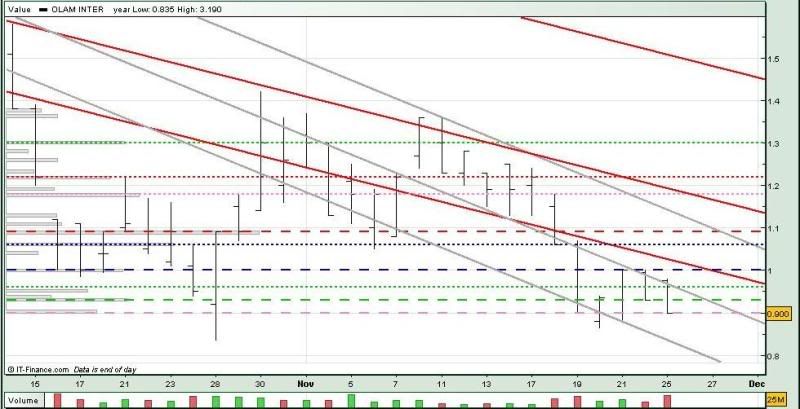
For tomorrow :
Support @ 0.900 (pink --), 0.835 (28 oct low), 0.813 (low grey)
Resistance @ 0.930 (green --), 0.945 (mid grey), 0.960 (green ...), 1.00 (blue --), 1.015 (low red)
The last time Olam traded below the 0.900 level was on 28 oct (0.835 low). If Olam breaks the 0.900 support, we could see it revisit this low. Would that have completed the double-bottom formation?

For tomorrow :
Support @ 0.900 (pink --), 0.835 (28 oct low), 0.813 (low grey)
Resistance @ 0.930 (green --), 0.945 (mid grey), 0.960 (green ...), 1.00 (blue --), 1.015 (low red)
Noble Group 251108
Noble Group continues to trade within the uptrend channel (blue), even testing the 0.795 neckline (pink --), uptrend resistance (mid blue), and downtrend resistance (mid pink), before ending the day below the long term downtrend resistance (low red).
Based on the volume distribution bars on the left, Noble Group also seems to have build up quite a support base at the 0.740 level (pink ...). However, we could see this base being severely tested in the next few days.
If Noble Group manages to hold onto this support, we could see attempt to break the 0.795 resistance (pink --) again. However, if Noble Group breaks the downtrend support (low pink), we could see it test the 0.685 support (red --).
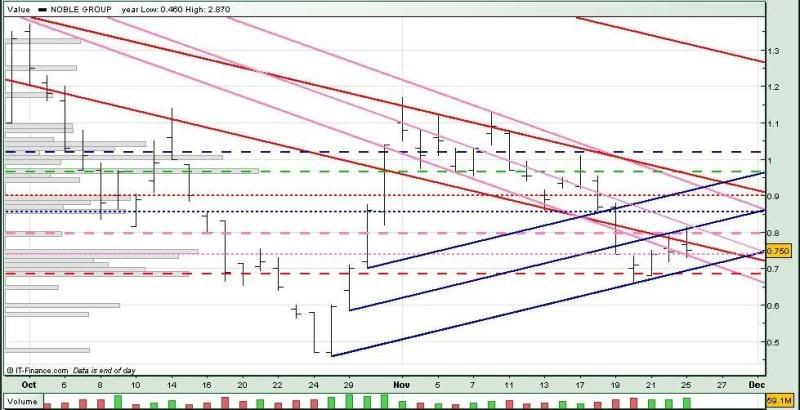
For tomorrow :
Support @ 0.740 (pink ...), 0.7185 (low pink), 0.705 (low blue), 0.685 (red --)
Resistance @ 0.760 (low red), 0.795 (pink --), 0.803 (mid pink), 0.820 (mid blue), 0.855 (blue ...)
Based on the volume distribution bars on the left, Noble Group also seems to have build up quite a support base at the 0.740 level (pink ...). However, we could see this base being severely tested in the next few days.
If Noble Group manages to hold onto this support, we could see attempt to break the 0.795 resistance (pink --) again. However, if Noble Group breaks the downtrend support (low pink), we could see it test the 0.685 support (red --).

For tomorrow :
Support @ 0.740 (pink ...), 0.7185 (low pink), 0.705 (low blue), 0.685 (red --)
Resistance @ 0.760 (low red), 0.795 (pink --), 0.803 (mid pink), 0.820 (mid blue), 0.855 (blue ...)
Indofood Agri 251108
There was joy (for the longists) initially when Indofoor Agri opened on the 0.420 neckline (pink --), breaking the long term downtrend resistance (upp pink) at the same time. Indofood Agri even came close to testing the downtrend resistance (mid red).
However, as the day went on, things began to take a turn for the worse when Indofood Agri began reversing, giving up its gains, breaking the 0.420 and 0.410 necklines. Indofood Agri then finished the day by closing right on the 0.395 support (pink ...).
If Indofood Agri breaks the 0.395 support, we could see it testing the end oct lows of 0.375 (blue --) again.
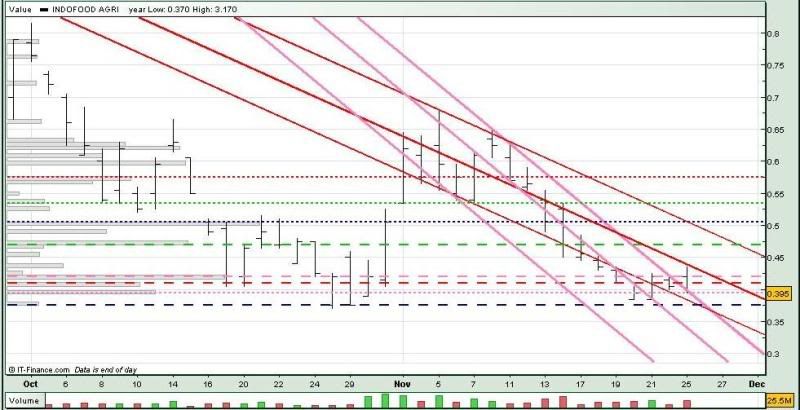
For tomorrow :
Support @ 0.395 (pink ...), 0.375 (upp pink, blue --), 0.370 (low red), 0.315 (mid pink)
Resistance @ 0.410 (red --), 0.420 (pink --), 0.425 (mid red), 0.470 (green --), 0.495 (upp red)
However, as the day went on, things began to take a turn for the worse when Indofood Agri began reversing, giving up its gains, breaking the 0.420 and 0.410 necklines. Indofood Agri then finished the day by closing right on the 0.395 support (pink ...).
If Indofood Agri breaks the 0.395 support, we could see it testing the end oct lows of 0.375 (blue --) again.

For tomorrow :
Support @ 0.395 (pink ...), 0.375 (upp pink, blue --), 0.370 (low red), 0.315 (mid pink)
Resistance @ 0.410 (red --), 0.420 (pink --), 0.425 (mid red), 0.470 (green --), 0.495 (upp red)
Cosco 251108
Could Cosco be forming a double-bottom? Although Cosco has not broken the 0.755 resistance (blue ...) yet, it managed to keep off the uptrend support (low blue) and 0.670 support (pink --) these 2 days.
We could see some action for Cosco towards the end of the week when the long term downtrend resistance (mid pink) meets the uptrend support (low blue) and 0.670 support (pink --).
If Cosco breaks these 2 supports, we could see Cosco re-vsiting 3-year lows.
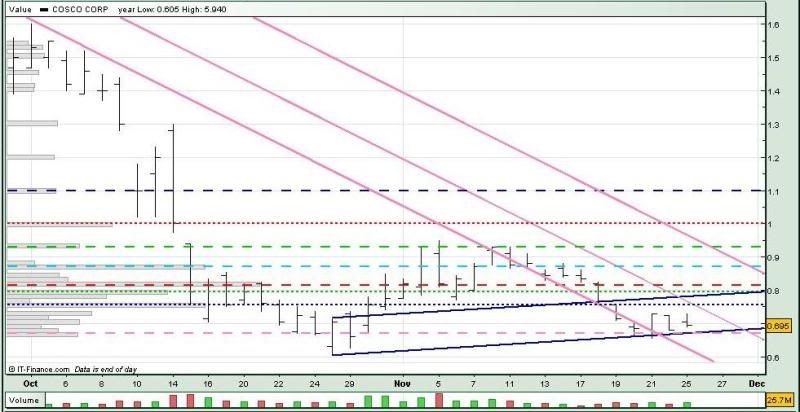
For tomorrow :
Support @ 0.670 (low blue, pink --), 0.600 (low pink)
Resistance @ 0.730 (min pink), 0.755 (blue ...), 0.785 (upp blue), 0.795 (green ...), 0.815 (red --)
We could see some action for Cosco towards the end of the week when the long term downtrend resistance (mid pink) meets the uptrend support (low blue) and 0.670 support (pink --).
If Cosco breaks these 2 supports, we could see Cosco re-vsiting 3-year lows.

For tomorrow :
Support @ 0.670 (low blue, pink --), 0.600 (low pink)
Resistance @ 0.730 (min pink), 0.755 (blue ...), 0.785 (upp blue), 0.795 (green ...), 0.815 (red --)
China Hongx 251108
China Hongxing continues to trade (more or less) between the 0.180 support (lightblue ...) and 0.190 resistance (lightblue --), probably trying to form a base. However, China Hongxing has been closing low the last 2 days, So I'm not sure how long more the 0.180 support can hold.
If the support breaks, the selling could come fast and furious, and China Hongxing could re-test the end oct lows.
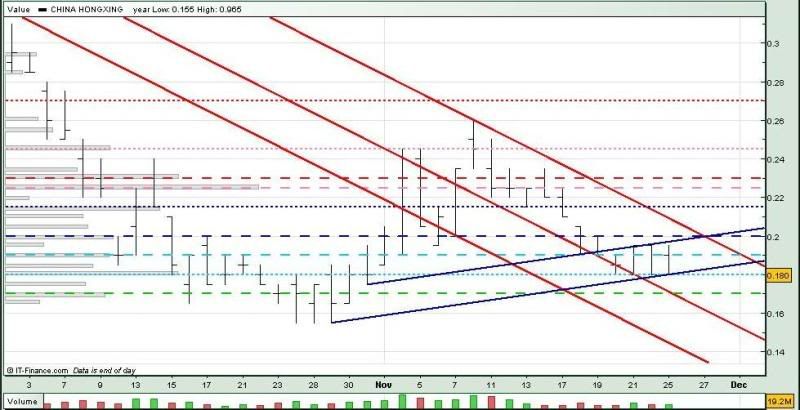
For tomorrow :
Support @ 0.180 (low blue, lightblue ...), 0.170 (green --), 0.165 (mid red), 0.140 (low red)
Resistance @ 0.190 (lightblue --), 0.197 (upp blue), 0.200 (blue --), 0.205 (upp red)
If the support breaks, the selling could come fast and furious, and China Hongxing could re-test the end oct lows.

For tomorrow :
Support @ 0.180 (low blue, lightblue ...), 0.170 (green --), 0.165 (mid red), 0.140 (low red)
Resistance @ 0.190 (lightblue --), 0.197 (upp blue), 0.200 (blue --), 0.205 (upp red)
Market starts week on weak note
by CONRAD TAN (25 Nov)
UOB and DBS are main drags on STI; gains by heavyweights SingTel and KepCorp help limit index's losses
STOCKS here started the week on a sour note yesterday as two of the world's biggest banks scrambled to raise capital, adding to fears that the unfolding economic crisis worldwide is taking its toll on even the biggest names.
The Straits Times Index (STI) finished 41.81 points or 2.5 per cent lower at 1,620.29, after slumping 2.6 per cent earlier in the day. United Overseas Bank (UOB) and DBS Group were the main drags on the index.
Around the region, bank stocks suffered after Standard Chartered Bank said it would raise £1.8 billion (S$4.1 billion) through a rights issue to boost its capital base and the US government agreed to bail out Citigroup by injecting US$20 billion into it and insuring up to US$306 billion of its troubled assets.
Here, UOB finished 3.8 per cent lower at $11.26, DBS fell 3.4 per cent to $9.27 and OCBC Bank ended 1.1 per cent down at $4.55.
In a report yesterday, DBS analysts said they remain 'cautious' on the local banking sector, despite the boost from the government's initiative announced last week to support lending to small and medium-size enterprises (SMEs).
'We believe this move by the government will ease credit worries, alleviate default risk of SMEs and restore confidence in the availability of credit to SMEs,' they said. Still, 'the key concerns ahead would be the extent of asset quality weakness the banks might face'.
Olam International, a supplier of agricultural commodities worldwide, led yesterday's blue-chip declines in percentage terms. It fell 7 per cent to 93 cents, revisiting last Wednesday's low. The stock has slumped 66.9 per cent this year amid a broader slide in commodity-related stocks, as the world's biggest economies tip into recession, hurting demand for a range of commodities.
But Hong Kong-based Noble Group, which manages global supply chains in food, energy and metals, defied the broader market yesterday, rising 0.7 per cent to 74.5 cents after slumping badly last week. For the year, the stock is still down 63.2 per cent.
Chinese shipyard operator Cosco Corp was the second-biggest loser in percentage terms among STI members, falling 6.8 per cent to 68 cents.
Of the STI's 30 component stocks, 25 fell, four rose and one finished unchanged. Index heavyweights SingTel and Keppel Corp were among the gainers, which helped limit the STI's losses. SingTel rose 1.2 per cent to $2.48 and KepCorp finished 0.2 per cent higher at $4.61.
Outside the STI, the broader market was also weak. Losing counters outnumbered gainers 284-108 overall, with 930 counters unchanged, excluding warrants and bonds. Trading volume was abysmally low.
Just 790.4 million units worth $650.3 million changed hands, compared with Friday's volume of 1.17 billion units worth $971.6 million. That includes warrants and bonds but excludes shares traded in foreign currencies.
CapitaCommercial Trust fell 8.2 per cent to 73 cents after the property trust said on Friday it was pursuing its refinancing needs with several financial institutions. A Reuters report that day suggested the trust had asked four banks to arrange $580 million in refinancing.
The FTSE ST All-Share index, which tracks 268 of the most liquid stocks listed here, fell 2.5 per cent yesterday, while the UOB Catalist index of stocks on the second board dipped 1.5 per cent.
Elsewhere in the region, most stock indices also ended lower, except in Japan where markets were closed for a public holiday. Hong Kong's Hang Seng Index slid 1.6 per cent.
-Research Report by CONRAD TAN (25 Nov)
UOB and DBS are main drags on STI; gains by heavyweights SingTel and KepCorp help limit index's losses
STOCKS here started the week on a sour note yesterday as two of the world's biggest banks scrambled to raise capital, adding to fears that the unfolding economic crisis worldwide is taking its toll on even the biggest names.
The Straits Times Index (STI) finished 41.81 points or 2.5 per cent lower at 1,620.29, after slumping 2.6 per cent earlier in the day. United Overseas Bank (UOB) and DBS Group were the main drags on the index.
Around the region, bank stocks suffered after Standard Chartered Bank said it would raise £1.8 billion (S$4.1 billion) through a rights issue to boost its capital base and the US government agreed to bail out Citigroup by injecting US$20 billion into it and insuring up to US$306 billion of its troubled assets.
Here, UOB finished 3.8 per cent lower at $11.26, DBS fell 3.4 per cent to $9.27 and OCBC Bank ended 1.1 per cent down at $4.55.
In a report yesterday, DBS analysts said they remain 'cautious' on the local banking sector, despite the boost from the government's initiative announced last week to support lending to small and medium-size enterprises (SMEs).
'We believe this move by the government will ease credit worries, alleviate default risk of SMEs and restore confidence in the availability of credit to SMEs,' they said. Still, 'the key concerns ahead would be the extent of asset quality weakness the banks might face'.
Olam International, a supplier of agricultural commodities worldwide, led yesterday's blue-chip declines in percentage terms. It fell 7 per cent to 93 cents, revisiting last Wednesday's low. The stock has slumped 66.9 per cent this year amid a broader slide in commodity-related stocks, as the world's biggest economies tip into recession, hurting demand for a range of commodities.
But Hong Kong-based Noble Group, which manages global supply chains in food, energy and metals, defied the broader market yesterday, rising 0.7 per cent to 74.5 cents after slumping badly last week. For the year, the stock is still down 63.2 per cent.
Chinese shipyard operator Cosco Corp was the second-biggest loser in percentage terms among STI members, falling 6.8 per cent to 68 cents.
Of the STI's 30 component stocks, 25 fell, four rose and one finished unchanged. Index heavyweights SingTel and Keppel Corp were among the gainers, which helped limit the STI's losses. SingTel rose 1.2 per cent to $2.48 and KepCorp finished 0.2 per cent higher at $4.61.
Outside the STI, the broader market was also weak. Losing counters outnumbered gainers 284-108 overall, with 930 counters unchanged, excluding warrants and bonds. Trading volume was abysmally low.
Just 790.4 million units worth $650.3 million changed hands, compared with Friday's volume of 1.17 billion units worth $971.6 million. That includes warrants and bonds but excludes shares traded in foreign currencies.
CapitaCommercial Trust fell 8.2 per cent to 73 cents after the property trust said on Friday it was pursuing its refinancing needs with several financial institutions. A Reuters report that day suggested the trust had asked four banks to arrange $580 million in refinancing.
The FTSE ST All-Share index, which tracks 268 of the most liquid stocks listed here, fell 2.5 per cent yesterday, while the UOB Catalist index of stocks on the second board dipped 1.5 per cent.
Elsewhere in the region, most stock indices also ended lower, except in Japan where markets were closed for a public holiday. Hong Kong's Hang Seng Index slid 1.6 per cent.
-Research Report by CONRAD TAN (25 Nov)
STI likely to consolidate further
by Ken Tai Chee Ming, CMT senior technical strategist, KELIVE RESEARCH (25 Nov)
BASED on Elliot Wave theorem, the Straits Times Index is currently trending in Wave-B downtrend of its Wave-4 cycle. At the macro front, the decline in commodity and oil prices is making a positive impact on the US external deficit and US dollar strength.

Coupled with the rising aversion to global risk, there is anecdotal evidence to suggest that US capital outflow to Asia is slowing down somewhat as funds re-balance their weightings in favour of US dollar assets.
If this prognosis is accurate, then Asian markets will likely consolidate further as the US dollar strengthens. For Singapore, MAS's shift towards a zero appreciation policy for the Sing dollar on Oct 9 had led to speculative shorts on the Sing dollar.
To date, the Sing dollar/US dollar exchange rate has depreciated from $1.47 to $1.53; the next resistance to watch is $1.543, followed by $1.592. We believe currency exchange levels will have a deterministic role in this phase of the STI's consolidation with index support at 1,570.
While it could be a wait before the Wave-C rebound arrives, potentially, a breakout of the recent 1,933 high achieved this October is plausible.
-Research Report by Ken Tai Chee Ming, CMT senior technical strategist, KELIVE RESEARCH (25 Nov)
BASED on Elliot Wave theorem, the Straits Times Index is currently trending in Wave-B downtrend of its Wave-4 cycle. At the macro front, the decline in commodity and oil prices is making a positive impact on the US external deficit and US dollar strength.
Coupled with the rising aversion to global risk, there is anecdotal evidence to suggest that US capital outflow to Asia is slowing down somewhat as funds re-balance their weightings in favour of US dollar assets.
If this prognosis is accurate, then Asian markets will likely consolidate further as the US dollar strengthens. For Singapore, MAS's shift towards a zero appreciation policy for the Sing dollar on Oct 9 had led to speculative shorts on the Sing dollar.
To date, the Sing dollar/US dollar exchange rate has depreciated from $1.47 to $1.53; the next resistance to watch is $1.543, followed by $1.592. We believe currency exchange levels will have a deterministic role in this phase of the STI's consolidation with index support at 1,570.
While it could be a wait before the Wave-C rebound arrives, potentially, a breakout of the recent 1,933 high achieved this October is plausible.
-Research Report by Ken Tai Chee Ming, CMT senior technical strategist, KELIVE RESEARCH (25 Nov)
Technical view on ST Index
by DMG AND PARTNERS SECURITIES (25 Nov)
STRAITS Times Index (STI): Edging closer to the 1,391 level.
We have previously noted that the STI is set to fall due to the Symmetrical Triangle pattern that had formed. While the STI did eventually drop 10.7 per cent to its intraday low of 1,570 during the previous week, we had underestimated the magnitude of the decline as we had expected the index to 'consolidate with a bearish tone' - the breakout move out of the Triangle had taken place slightly earlier than we have anticipated.
We had also mentioned that the break below the 1,600-1,717 region would imply that the index is set to target the 1,391 mark to complete the 161.8 per cent move of Wave A. While this view remains and with the STI still in the midst of a Wave C, we now note that this level should be attained by January.
As for our weekly short-term view for the STI, we believe that any rebounds should be shortlived. With the potential bearish moving average crossover on the MACD chart looming, the breakout move from the Triangle looks poised to continue. Additionally, the 14-day RSI is still hovering above the 30 level, suggesting that the STI is not yet oversold.
Support is set at the 1,570-1,580 area which is in line with the lower bollinger band while resistance is derived at the 1,760-1,770 range as depicted by the confluence of the 14- and 21-day moving averages.
-Research Report by DMG AND PARTNERS SECURITIES (25 Nov)
STRAITS Times Index (STI): Edging closer to the 1,391 level.
We have previously noted that the STI is set to fall due to the Symmetrical Triangle pattern that had formed. While the STI did eventually drop 10.7 per cent to its intraday low of 1,570 during the previous week, we had underestimated the magnitude of the decline as we had expected the index to 'consolidate with a bearish tone' - the breakout move out of the Triangle had taken place slightly earlier than we have anticipated.
We had also mentioned that the break below the 1,600-1,717 region would imply that the index is set to target the 1,391 mark to complete the 161.8 per cent move of Wave A. While this view remains and with the STI still in the midst of a Wave C, we now note that this level should be attained by January.
As for our weekly short-term view for the STI, we believe that any rebounds should be shortlived. With the potential bearish moving average crossover on the MACD chart looming, the breakout move from the Triangle looks poised to continue. Additionally, the 14-day RSI is still hovering above the 30 level, suggesting that the STI is not yet oversold.
Support is set at the 1,570-1,580 area which is in line with the lower bollinger band while resistance is derived at the 1,760-1,770 range as depicted by the confluence of the 14- and 21-day moving averages.
-Research Report by DMG AND PARTNERS SECURITIES (25 Nov)
The End Is Near?
Is the market finally turning around? Depends on how you look at it. Saw this cartoon on Newsweek. Really sums up the situation now.
 Different people, different perspectives.
Different people, different perspectives.
Monday, November 24, 2008
More than just rig builders
by VINCENT WEE (24 Nov)
LOOKING at the one-year price charts of SembCorp Marine, Keppel Corp and the benchmark crude oil grade, a close correlation appears.
Both SembMarine and Keppel Corp hit highs of $4.61 and $12.34 respectively on June 2, when the price of crude oil was on an unprecedented uptrend and just a month before it hit an all-time high of over US$147 in July.
When the oil price started sliding below US$100 per barrel after that high point, the stock prices of the two counters followed suit. And when oil prices briefly spiked back up above US$100, the stock prices of the two counters mirrored this movement, albeit on a much smaller scale.
With oil falling below US$50 last Thursday, the prospects for the two counters look poor if investors were to assume that the correlation will hold. However, the fundamental question that needs to be asked is if that rationale for the correlation was valid in the first place.
Firstly, new order announcements have slowed, not stopped, in the second half. Keppel Offshore and Marine managing director and chief operating officer Tong Chong Heong was recently quoted as saying that the group had 'not yet reached a point of panic' because most of its projects were properly funded and the yards had work all the way till about 2012 to 2013 with a net order book of $13 billion as at Sept 30.
Trying to pin down an oil price at which continued investment in new rigs will stop is at best an academic exercise. But the fact remains that demand for oil will continue to rise and so will the demand for rigs needed to find that oil.
According to a recent report by Ocean Shipping Consultants, even in a low case (price) scenario, offshore oil production is forecast to increase by 39 per cent between now and 2020.
The other key fact is that even as oil demand increases, the supply of rigs will not keep pace. Over 65 per cent of the global mobile rig fleet is over 25 years old and should be due for scrapping but owners have deferred this due to high current charter rates. New building orders account for just 20 per cent of the current offshore rig fleet.
Secondly, while both companies are known as rig builders accounting for more than two-thirds of global newbuilds and while it seems that the big rig deals with impressive headline numbers have tapered off, it should be realised that this is not all that they can do. For example, each of them are also recognised ship repair and conversion yards in their own right.
In fact, the margins on some of the other less attention-grabbing jobs they undertake are actually better than the rig jobs. Repair and conversion jobs see average margins of 25-30 per cent while the usual margin on a rig newbuild is no more than 10 per cent.
Nonetheless, contracts continue to trickle in and the type of jobs being secured seem to be indicating just such a shift.
Keppel announced several conversion and fabrication contracts worth a total of $340 million last week. SembMarine's most recent contract for the first in a series of LNG carrier life extensions was just last month.
DMG and Partners analyst Serene Lim notes in a recent report on SembMarine that 'the repair and conversion business division is counter-cyclical in nature'.
'In this weak credit market whereby we could possibly expect slowing new order momentum, we believe this non-rig building segment is likely to bring in relatively stable revenue stream.'
' We noted that historically, these combined revenue contributions from repair and conversion projects had been increasing through these years, $1.4 billion in FY05, $1.5 billion in FY06 and $1.9 billion in FY07,' she adds, maintaining her 'buy' call and a target price of $2.49.
OCBC Investment Research's Kelly Chia, meanwhile, resumed coverage of Keppel with a 'buy' call also and a fair value price of $5.20.
-Research Report by VINCENT WEE (24 Nov)
LOOKING at the one-year price charts of SembCorp Marine, Keppel Corp and the benchmark crude oil grade, a close correlation appears.
Both SembMarine and Keppel Corp hit highs of $4.61 and $12.34 respectively on June 2, when the price of crude oil was on an unprecedented uptrend and just a month before it hit an all-time high of over US$147 in July.
When the oil price started sliding below US$100 per barrel after that high point, the stock prices of the two counters followed suit. And when oil prices briefly spiked back up above US$100, the stock prices of the two counters mirrored this movement, albeit on a much smaller scale.
With oil falling below US$50 last Thursday, the prospects for the two counters look poor if investors were to assume that the correlation will hold. However, the fundamental question that needs to be asked is if that rationale for the correlation was valid in the first place.
Firstly, new order announcements have slowed, not stopped, in the second half. Keppel Offshore and Marine managing director and chief operating officer Tong Chong Heong was recently quoted as saying that the group had 'not yet reached a point of panic' because most of its projects were properly funded and the yards had work all the way till about 2012 to 2013 with a net order book of $13 billion as at Sept 30.
Trying to pin down an oil price at which continued investment in new rigs will stop is at best an academic exercise. But the fact remains that demand for oil will continue to rise and so will the demand for rigs needed to find that oil.
According to a recent report by Ocean Shipping Consultants, even in a low case (price) scenario, offshore oil production is forecast to increase by 39 per cent between now and 2020.
The other key fact is that even as oil demand increases, the supply of rigs will not keep pace. Over 65 per cent of the global mobile rig fleet is over 25 years old and should be due for scrapping but owners have deferred this due to high current charter rates. New building orders account for just 20 per cent of the current offshore rig fleet.
Secondly, while both companies are known as rig builders accounting for more than two-thirds of global newbuilds and while it seems that the big rig deals with impressive headline numbers have tapered off, it should be realised that this is not all that they can do. For example, each of them are also recognised ship repair and conversion yards in their own right.
In fact, the margins on some of the other less attention-grabbing jobs they undertake are actually better than the rig jobs. Repair and conversion jobs see average margins of 25-30 per cent while the usual margin on a rig newbuild is no more than 10 per cent.
Nonetheless, contracts continue to trickle in and the type of jobs being secured seem to be indicating just such a shift.
Keppel announced several conversion and fabrication contracts worth a total of $340 million last week. SembMarine's most recent contract for the first in a series of LNG carrier life extensions was just last month.
DMG and Partners analyst Serene Lim notes in a recent report on SembMarine that 'the repair and conversion business division is counter-cyclical in nature'.
'In this weak credit market whereby we could possibly expect slowing new order momentum, we believe this non-rig building segment is likely to bring in relatively stable revenue stream.'
' We noted that historically, these combined revenue contributions from repair and conversion projects had been increasing through these years, $1.4 billion in FY05, $1.5 billion in FY06 and $1.9 billion in FY07,' she adds, maintaining her 'buy' call and a target price of $2.49.
OCBC Investment Research's Kelly Chia, meanwhile, resumed coverage of Keppel with a 'buy' call also and a fair value price of $5.20.
-Research Report by VINCENT WEE (24 Nov)
Next week 24 - 28 Nov Data
US DATA
Nov 24
Oct existing home sales
Nov 25
Chain deflator - Q3
preliminary results
GDP - Q3 preliminary
Nov consumer confidence
Nov 26
Oct durable orders
Initial job claims
Oct personal income
Oct personal spending
Nov Chicago PMI
Oct new home sales
SINGAPORE DATA
Nov 24
Oct consumer price index
Nov 26
Oct index of industrial production
Nov 28
Oct central government operations
Oct producer and international trade price indices
Nov 24
Oct existing home sales
Nov 25
Chain deflator - Q3
preliminary results
GDP - Q3 preliminary
Nov consumer confidence
Nov 26
Oct durable orders
Initial job claims
Oct personal income
Oct personal spending
Nov Chicago PMI
Oct new home sales
SINGAPORE DATA
Nov 24
Oct consumer price index
Nov 26
Oct index of industrial production
Nov 28
Oct central government operations
Oct producer and international trade price indices
Saturday, November 22, 2008
Week shows the worst not over
by R SIVANITHY (20 Nov)
NOTWITHSTANDING yesterday's short - covering bounce, the week just passed has served as a grim reminder to investors everywhere that the worst is not yet over for equities.
Wall Street's collapse throughout the week on deflationary worries as oil prices continued to crash, Citibank's plummet to US$4.71 per share on Thursday on worries about its future, the likelihood that General Motors might go bust, the awful US jobless and housing numbers, the US Treasury abandoning its supposedly crucial US$700 billion bailout plan - the list goes ever on.
Whatever the case, few observers placed any faith in yesterday's 48.15-point gain for the Straits Times Index (STI), most probably taking the opportunity to sell into short-covering strength.
For the week, the STI lost 97 points or 5.5 per cent to 1,662.10, falling continuously between Monday and Thursday. Not surprisingly, banks were hit again - DBS started the week at $10.34 but ended at $9.60 for a loss of more than 7 per cent, UOB's loss was one per cent and OCBC's 6 per cent.
Daiwa Institute of Research's Nov 19 report on the banks probably summed it up best when it said there is no reason to change its negative view on the sector after the Q3 results. 'We believe the quarterly net profit declines (average of 23 per cent) experienced by all banks for Q3 are a precursor of the weak operating conditions they face in 2009 and 2010,' said Daiwa.
Morgan Stanley (MS), in the meantime, said in its Nov 19 Asia Pacific Banks report that it has identified 39 banks in its regional coverage that may require some form of equity raising (ordinary equity issuance, dividend policy change, divestment, etc), to just increase their core equity tier one ratio to at least 9 per cent which amounts to about US$80 billion in new equity.
'The US$80 billion does not include capital strain/destruction from the emerging credit cycle and macro slowdown. At this stage, we have no clear view on the likely depth and breadth of these cycles, but suffice to say US$80 billion is unlikely to be enough.
Moreover, as the developed world moves to higher levels of absolute capital adequacy, will rating agencies and capital providers require Asia to maintain the previous relative gap ... ie, is even 9 per cent core equity tier one enough?' asked MS.
In his weekly roundup, AMP Capital's strategy head Shane Oliver said with the US's leading indicator of economic growth at its lowest reading in over 15 years, the worsening outlook means the US Federal Reserve will have to cut its short-term interest rates again at next month's meeting.
Next week, Wall Street will be closed on Thursday for Thanksgiving but will have to deal with a barrage of economic reports such as home sales, house prices, consumer confidence and durable goods orders.
As for the local market, DBS Vickers yesterday released a Singapore Market Focus entitled 'Cautious' in which it said with earnings deteriorating and assuming a recession with -2 per cent GDP growth, the STI could test 1,250.
-Research Report by R SIVANITHY (20 Nov)
NOTWITHSTANDING yesterday's short - covering bounce, the week just passed has served as a grim reminder to investors everywhere that the worst is not yet over for equities.
Wall Street's collapse throughout the week on deflationary worries as oil prices continued to crash, Citibank's plummet to US$4.71 per share on Thursday on worries about its future, the likelihood that General Motors might go bust, the awful US jobless and housing numbers, the US Treasury abandoning its supposedly crucial US$700 billion bailout plan - the list goes ever on.
Whatever the case, few observers placed any faith in yesterday's 48.15-point gain for the Straits Times Index (STI), most probably taking the opportunity to sell into short-covering strength.
For the week, the STI lost 97 points or 5.5 per cent to 1,662.10, falling continuously between Monday and Thursday. Not surprisingly, banks were hit again - DBS started the week at $10.34 but ended at $9.60 for a loss of more than 7 per cent, UOB's loss was one per cent and OCBC's 6 per cent.
Daiwa Institute of Research's Nov 19 report on the banks probably summed it up best when it said there is no reason to change its negative view on the sector after the Q3 results. 'We believe the quarterly net profit declines (average of 23 per cent) experienced by all banks for Q3 are a precursor of the weak operating conditions they face in 2009 and 2010,' said Daiwa.
Morgan Stanley (MS), in the meantime, said in its Nov 19 Asia Pacific Banks report that it has identified 39 banks in its regional coverage that may require some form of equity raising (ordinary equity issuance, dividend policy change, divestment, etc), to just increase their core equity tier one ratio to at least 9 per cent which amounts to about US$80 billion in new equity.
'The US$80 billion does not include capital strain/destruction from the emerging credit cycle and macro slowdown. At this stage, we have no clear view on the likely depth and breadth of these cycles, but suffice to say US$80 billion is unlikely to be enough.
Moreover, as the developed world moves to higher levels of absolute capital adequacy, will rating agencies and capital providers require Asia to maintain the previous relative gap ... ie, is even 9 per cent core equity tier one enough?' asked MS.
In his weekly roundup, AMP Capital's strategy head Shane Oliver said with the US's leading indicator of economic growth at its lowest reading in over 15 years, the worsening outlook means the US Federal Reserve will have to cut its short-term interest rates again at next month's meeting.
Next week, Wall Street will be closed on Thursday for Thanksgiving but will have to deal with a barrage of economic reports such as home sales, house prices, consumer confidence and durable goods orders.
As for the local market, DBS Vickers yesterday released a Singapore Market Focus entitled 'Cautious' in which it said with earnings deteriorating and assuming a recession with -2 per cent GDP growth, the STI could test 1,250.
-Research Report by R SIVANITHY (20 Nov)
Friday, November 21, 2008
More selling as recession fears mount
by R SIVANITHY (20 Nov)
ST Index sheds 3 per cent as part of region-wide stocks hammering after Wall Street dives
WALL Street's 5 per cent plunge to a five-and- a-half-year low on Wednesday sent stocks in this part of the world tumbling yesterday, serving a grim reminder to investors everywhere that the worst is not over for equities.
The US market's rout came after the release of more poor economic numbers, including thin housing starts and low consumer prices - with both figures fuelling deflationary worries.
Adding to the gloom yesterday was news that Japan's exports fell the most in six years, confirming that the global slowdown is taking a firm grip.
The result was a 4 per cent slump in Hong Kong's Hang Seng Index and a 51.64-point or 3.1 per cent loss for the Straits Times Index to 1,613.95, taking it about 13 points above its most recent low of 1,600.28, reached on Oct 24.
Banks were again hit. All three closed weaker, led by DBS's 34-cent slide to $9.16. Daiwa Institute of Research said in a Wednesday report on Singapore banks that it sees no reason to change a previous 'negative' view of the sector.
'We believe the quarterly net profit decreases (an average of 23 per cent) experienced by all banks for Q308 are a precursor of the weak operating conditions they will face in 2009 and 2010,' Daiwa said.
'We believe the sector is set for another depressing industry-wide decline of 8.2 per cent year-on-year for 2009, led by further year-on-year declines in fees and other income and a flare-up of loan-related allowances.' It maintained its 'underperform' ratings on UOB and OCBC, and a 'hold' on DBS.
Government-linked conglomerates continued to be sold down yesterday, though Keppel Corp managed to close unchanged at $4.49 after touching $4.30. Sembcorp Industries (SCI) dropped 12 cents to $2.03, while Sembcorp Marine (SMM) fell 15 cents to $1.65.
In a Nov 18 report, Deutsche Bank maintained a 'buy' on all the three stocks, with price targets of $7.80, $3.55 and $2.45 for Keppel, SCI and SMM respectively.
'While near-term uncertainties remain due to the global financial and economic turmoil, we believe long-term trends remain intact for the offshore and marine sector and through a flight to quality, may likely see future orders gravitate towards the more established players,' said Deutsche.
Credit Suisse maintained its 'underweight' rating on Singapore in a Nov 19 strategy report, saying 'low solvency risk does not mean no risk'. It did state, however, that Singapore Inc is well-placed to weather the storm because corporate debt at 32 per cent for FY08 is easily manageable.
In his latest Insights, AMP Capital's strategy head Shane Oliver said recession is now advanced in key developed economies such as Japan and Europe, and it is only a matter of time before the US officially declares that it too is in recession.
He also said that although there are some common features, this is not a normal slump that typically comes as part of a boom-bust cycle.
'Two considerations make this global slump potentially more serious and hence add to the level of uncertainty,' he said. 'First, we are faced with significant systemic risk as the flow of credit has been radically impaired. On top of this, most countries are weakening at the same time. The synchronisation in economic downturns in the US, Japan and Europe is now making the global downturn worse.'
-Research Report by R SIVANITHY (20 Nov)
ST Index sheds 3 per cent as part of region-wide stocks hammering after Wall Street dives
WALL Street's 5 per cent plunge to a five-and- a-half-year low on Wednesday sent stocks in this part of the world tumbling yesterday, serving a grim reminder to investors everywhere that the worst is not over for equities.
The US market's rout came after the release of more poor economic numbers, including thin housing starts and low consumer prices - with both figures fuelling deflationary worries.
Adding to the gloom yesterday was news that Japan's exports fell the most in six years, confirming that the global slowdown is taking a firm grip.
The result was a 4 per cent slump in Hong Kong's Hang Seng Index and a 51.64-point or 3.1 per cent loss for the Straits Times Index to 1,613.95, taking it about 13 points above its most recent low of 1,600.28, reached on Oct 24.
Banks were again hit. All three closed weaker, led by DBS's 34-cent slide to $9.16. Daiwa Institute of Research said in a Wednesday report on Singapore banks that it sees no reason to change a previous 'negative' view of the sector.
'We believe the quarterly net profit decreases (an average of 23 per cent) experienced by all banks for Q308 are a precursor of the weak operating conditions they will face in 2009 and 2010,' Daiwa said.
'We believe the sector is set for another depressing industry-wide decline of 8.2 per cent year-on-year for 2009, led by further year-on-year declines in fees and other income and a flare-up of loan-related allowances.' It maintained its 'underperform' ratings on UOB and OCBC, and a 'hold' on DBS.
Government-linked conglomerates continued to be sold down yesterday, though Keppel Corp managed to close unchanged at $4.49 after touching $4.30. Sembcorp Industries (SCI) dropped 12 cents to $2.03, while Sembcorp Marine (SMM) fell 15 cents to $1.65.
In a Nov 18 report, Deutsche Bank maintained a 'buy' on all the three stocks, with price targets of $7.80, $3.55 and $2.45 for Keppel, SCI and SMM respectively.
'While near-term uncertainties remain due to the global financial and economic turmoil, we believe long-term trends remain intact for the offshore and marine sector and through a flight to quality, may likely see future orders gravitate towards the more established players,' said Deutsche.
Credit Suisse maintained its 'underweight' rating on Singapore in a Nov 19 strategy report, saying 'low solvency risk does not mean no risk'. It did state, however, that Singapore Inc is well-placed to weather the storm because corporate debt at 32 per cent for FY08 is easily manageable.
In his latest Insights, AMP Capital's strategy head Shane Oliver said recession is now advanced in key developed economies such as Japan and Europe, and it is only a matter of time before the US officially declares that it too is in recession.
He also said that although there are some common features, this is not a normal slump that typically comes as part of a boom-bust cycle.
'Two considerations make this global slump potentially more serious and hence add to the level of uncertainty,' he said. 'First, we are faced with significant systemic risk as the flow of credit has been radically impaired. On top of this, most countries are weakening at the same time. The synchronisation in economic downturns in the US, Japan and Europe is now making the global downturn worse.'
-Research Report by R SIVANITHY (20 Nov)
China Hongx 211108
China Hongxing opened right on the downtrend (mid red) and 0.180 support (lightblue...) before recovering to close above the 0.190 neckline (lightblue --). However, China Hongxing is still trading within the downtrend channel (red).
If China Hongxing continues to trade within the uptrend channel (blue), and above the 0.190 neckline (lightblue --), we could see it testing the 0.205 resistance (blue --) next week, which is also where the downtrend resistance (upp red) meets the uptrend resistance (upp blue).
However, if China Hongxing breaks the 0.180 support, we could see it test the oct lows again.
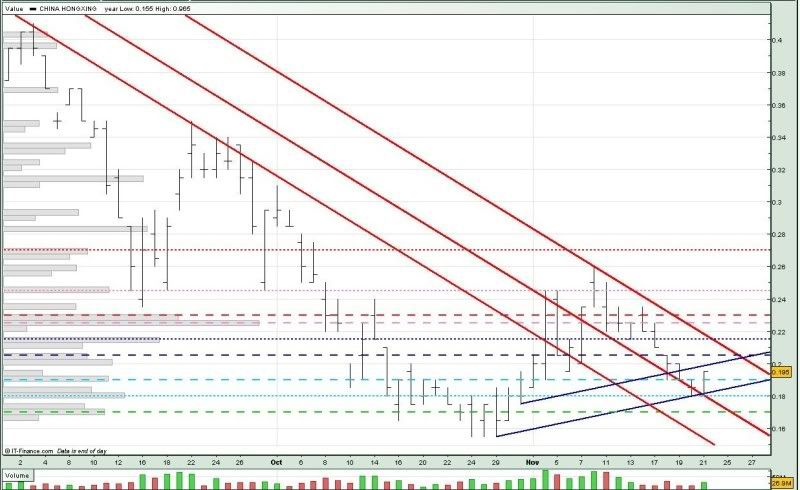
For monday :
Support @ 0.190 (lightblue --), 0.183 (low blue), 0.180 (lightblue ...), 0.175 (mid red), 0.170 (green --)
Resistance @ 0.200 (upp blue), 0.205 (blue --), 0.213 (upp red), 0.215 (blue ...)
If China Hongxing continues to trade within the uptrend channel (blue), and above the 0.190 neckline (lightblue --), we could see it testing the 0.205 resistance (blue --) next week, which is also where the downtrend resistance (upp red) meets the uptrend resistance (upp blue).
However, if China Hongxing breaks the 0.180 support, we could see it test the oct lows again.

For monday :
Support @ 0.190 (lightblue --), 0.183 (low blue), 0.180 (lightblue ...), 0.175 (mid red), 0.170 (green --)
Resistance @ 0.200 (upp blue), 0.205 (blue --), 0.213 (upp red), 0.215 (blue ...)
Thursday, November 20, 2008
3-day selling spree cuts 5% off STI
by R SIVANITHY (19 Nov)
Weak global economy, shaky Wall Street and poor earnings visibility weigh on index
THE fortunes of the Straits Times Index (STI) were almost entirely dictated yesterday by Hong Kong's Hang Seng Index. The local index exhibited a near-perfect correlation on a minute to minute basis with the former British colony's main benchmark throughout the day. As a result, it registered the same volatility as the Hang Seng, eventually finishing a net 26.96 points down at 1,665.59.
The Hang Seng, which spiked higher at mid-afternoon, closed with a net loss of 0.8 per cent. At 5pm, the December futures on the Dow Jones Industrial Average had lost 105 points, suggesting a weak Wednesday opening for Wall Street.
It was the STI's third consecutive fall, for a loss of 94 points or 5.3 per cent since the start of the week. The sick global economy, the shaky and probably overvalued Wall Street and poor earnings visibility in the wake of the US sub-prime crisis are the main reasons for the slide.
Brokers say sentiment continues to be influenced by a seemingly never-ending stream of bad news.
Coal mining firm Straits Asia Resources' (SAR) shares stood out in terms of weakness yesterday, by virtue of a 14.5-cent or 19 per cent crash to 60.5 cents on volume of 66 million.
OCBC Investment Research called a 'buy' on SAR. 'Its Q308 earnings have surged 707 per cent year on year and we expect FY09 to be even stronger, driven by record coal prices locked in during the commodity boom in 2008, coupled with easing production costs and retreating fuel prices.
Its 60 per cent dividend payout offers an attractive year-to-date yield of 9.5 per cent. Following our chat with management, we have tweaked our FY08 and FY09 estimates by -9 to +7 per cent. This raises our fair-value estimate to $1.35 from $1.25.'
Kim Eng Research said yesterday its top pick among conglomerates is ST Engineering (ST Engg). 'While having fallen 24 per cent since the onset of the global financial meltdown, ST Engg has been a relative outperformer in the current market, with the STI down 38 per cent over the same period.
ST Engg has also stabilised at its current level, making it an attractive pick in a volatile market, crucially backed by its FY09 dividend yield of 8.4 per cent.' ST Engg fell one cent yesterday to $2.13.
DMG & Partners said it has spent the past few weeks reviewing the financial forecasts and price targets for all the stocks under its coverage. 'With the cuts in price targets, we now arrive at a fair STI target of 2,080 over the next 12 months,' it said.
'However, in the short term we see further weakness that could take the STI to as low as 0.95 times P/B, or a 1,560 level. With the downside of about 10 per cent from the current STI level and difficulty in pinpointing the exact bottom, we recommend investors start nibbling at stocks that will survive this crisis.' The broker recommended companies with strong balance sheets.
In a Hong Kong Economics report dated Tuesday, Merrill Lynch said the unemployment rate there rose to 3.5 per cent in August-September, from 3.4 per cent in July-September.
'Given this is a lagging indicator, the already-worsened labour market is yet to be seen,' it said. 'We expect unemployment to hit 5 per cent in 2009. The weakening employment market once again lends support to our view that the economy has fallen into a recession. We continue to expect Hong Kong to post negative year-on-year GDP growth for the next two quarters and eventually finish the year with zero growth.'
-Research Report by R SIVANITHY (19 Nov)
Weak global economy, shaky Wall Street and poor earnings visibility weigh on index
THE fortunes of the Straits Times Index (STI) were almost entirely dictated yesterday by Hong Kong's Hang Seng Index. The local index exhibited a near-perfect correlation on a minute to minute basis with the former British colony's main benchmark throughout the day. As a result, it registered the same volatility as the Hang Seng, eventually finishing a net 26.96 points down at 1,665.59.
The Hang Seng, which spiked higher at mid-afternoon, closed with a net loss of 0.8 per cent. At 5pm, the December futures on the Dow Jones Industrial Average had lost 105 points, suggesting a weak Wednesday opening for Wall Street.
It was the STI's third consecutive fall, for a loss of 94 points or 5.3 per cent since the start of the week. The sick global economy, the shaky and probably overvalued Wall Street and poor earnings visibility in the wake of the US sub-prime crisis are the main reasons for the slide.
Brokers say sentiment continues to be influenced by a seemingly never-ending stream of bad news.
Coal mining firm Straits Asia Resources' (SAR) shares stood out in terms of weakness yesterday, by virtue of a 14.5-cent or 19 per cent crash to 60.5 cents on volume of 66 million.
OCBC Investment Research called a 'buy' on SAR. 'Its Q308 earnings have surged 707 per cent year on year and we expect FY09 to be even stronger, driven by record coal prices locked in during the commodity boom in 2008, coupled with easing production costs and retreating fuel prices.
Its 60 per cent dividend payout offers an attractive year-to-date yield of 9.5 per cent. Following our chat with management, we have tweaked our FY08 and FY09 estimates by -9 to +7 per cent. This raises our fair-value estimate to $1.35 from $1.25.'
Kim Eng Research said yesterday its top pick among conglomerates is ST Engineering (ST Engg). 'While having fallen 24 per cent since the onset of the global financial meltdown, ST Engg has been a relative outperformer in the current market, with the STI down 38 per cent over the same period.
ST Engg has also stabilised at its current level, making it an attractive pick in a volatile market, crucially backed by its FY09 dividend yield of 8.4 per cent.' ST Engg fell one cent yesterday to $2.13.
DMG & Partners said it has spent the past few weeks reviewing the financial forecasts and price targets for all the stocks under its coverage. 'With the cuts in price targets, we now arrive at a fair STI target of 2,080 over the next 12 months,' it said.
'However, in the short term we see further weakness that could take the STI to as low as 0.95 times P/B, or a 1,560 level. With the downside of about 10 per cent from the current STI level and difficulty in pinpointing the exact bottom, we recommend investors start nibbling at stocks that will survive this crisis.' The broker recommended companies with strong balance sheets.
In a Hong Kong Economics report dated Tuesday, Merrill Lynch said the unemployment rate there rose to 3.5 per cent in August-September, from 3.4 per cent in July-September.
'Given this is a lagging indicator, the already-worsened labour market is yet to be seen,' it said. 'We expect unemployment to hit 5 per cent in 2009. The weakening employment market once again lends support to our view that the economy has fallen into a recession. We continue to expect Hong Kong to post negative year-on-year GDP growth for the next two quarters and eventually finish the year with zero growth.'
-Research Report by R SIVANITHY (19 Nov)
Singapore Strategy
by DMG & Partners Securities (19 Nov)
TARGETING survivors: Some corporates may not have banks' support through this rough patch. The market remains concerned about the impact of global economic deterioration on corporate earnings.
Investors are closely scrutinising companies that have overstretched via massive borrowings to fund their growth, or have yet to generate sufficient operating cash flow, as these corporates are at the highest risk of breaching bank covenants if business conditions worsen further.
On the other hand, there are corporates whose balance sheets are strong. Even with the deterioration in business conditions, banks will continue to support these corporates for their working capital and capital expenditure needs.
These are the companies that are seen to survive this downturn. When economic conditions eventually improve, these companies could return to similar levels of profit or even exceed their previous peak profit levels.
Over the past few weeks, we have reviewed the financial forecasts and TPs for all the stocks under our coverage. With the cuts in TPs, we now arrive at a fair Straits Times Index (STI) target of 2,080 over the next 12 months.
However, in the short term, we see further weakness which could bring the STI to as low as 0.95 times P/B, or a 1,560 level. With the downside of about 10 per cent from the current STI level and difficulty in pinpointing the exact bottom, we recommend investors to start nibbling at stocks that will survive this crisis.
We have identified the following big-cap stocks which we believe will ride through the crisis and emerge stronger:
CapitaLand ('buy', TP: $3.05): At current levels, CapitaLand is trading at a 24.4 per cent discount to its end-Q3 2008 NAV of $3.60. During past crises, CapitaLand has been trading at 40-60 per cent discount to NAV. Taking the view that CapitaLand is now of a different stead compared to then, we have pegged our RNAV base-case value of $5.05 to a 40 per cent discount, implying end-2009 fair value of $3.05.
Risks include further tightening of credit markets and more macroeconomic dampeners. Catalysts include more government measures to prop up domestic residential property markets and further timely divestments or acquisitions.
ComfortDelGro ('buy', TP: $1.63): Plunging crude oil prices will stimulate earnings.
Sembcorp Marine ('buy', TP: $2.49): Sustainable amid challenging conditions. Our earnings forecasts have factored in slowing new order momentum.
Singapore Press Holdings ('buy', TP: $4.35): Over the years, SPH has successfully diversified its business, moving into magazines, property and the Internet. Recurring income in the current two financial years should be aided by the property segment, thanks to high rentals for its flagship Paragon mall as well as its sold-out Sky@eleven project.
StarHub ('buy', TP: $2.68): There have been some concerns over its gearing, but a closer look at its financials would bring comfort to investors. Net gearing for the company stood at 7.6 times in Q3 2008, which ranks it among the highest in the market.
However, there was a capital repayment of $1.1 billion, which resulted in shareholders' equity shrinking to a mere $103 million. If not for this, the net gearing would have only been 0.7 times - a decent figure, given that StarHub paid out dividends of $621 million in 2005-07, and declared another $230 million this year. The cash it generates is also more than sufficient to repay its debts.
ST Engineering ('buy', TP: $2.83): Robust financials, good cash flows from operations, long-term prospects still bullish, and orders remain strong.
United Overseas Bank ('buy', TP: $16.00): Conservative loan expansion over the past four years will keep non-performing loans contained. Our earnings forecasts have factored in huge loan provisions. Interest income should be cushioned by its relatively high loan-to-deposit ratio.
Other mid-cap stocks that also deserve attention are:
Ascendas Reit ('buy', TP: $1.75): Its present price presents a good entry point for investors to buy into a strong sponsor-backed industrial Reit with quality assets and an established track record, as well as stable income backed by long lease tenures.
China Milk ('buy', TP: $0.52): The company is able to generate consistent free cash flows over the years. We believe China Milk can ride through this crisis well.
Indofood Agri Resources ('buy', TP: $1.12): Indofood Agri has the ability to obtain refinancing for its short-term debt, despite the current credit tightening environment. While lower crude palm oil prices will affect earnings, this is partially mitigated by Indofood Agri's growing cooking oil & fats segment.
Li Heng Chemical Fibre ('buy', TP: $0.685): With capital expenses fully budgeted for, and at least another one billion yuan ($224 million) worth of operating cash inflow from H2 2008 to FY2009, the group should be able to withstand any further repercussions from the credit crisis and a slowdown in its business environment.
Raffles Medical Group ('buy', TP: $0.77): Strong operating cash flows should help it face challenges ahead. It has a healthy patient load, a diversified patient base, and a healthy balance sheet.
Venture Corp ('buy', TP: $7.40): Venture has managed to generate quarterly revenue and core operating profit exceeding $900 million and $66 million, respectively, since Q1 2007. While the prospects for Venture may have taken a step back in recent times due to the global economic downturn, we do believe that the present selldown in its share price appears over-extended.
-Research Report by DMG & Partners Securities (19 Nov)
TARGETING survivors: Some corporates may not have banks' support through this rough patch. The market remains concerned about the impact of global economic deterioration on corporate earnings.
Investors are closely scrutinising companies that have overstretched via massive borrowings to fund their growth, or have yet to generate sufficient operating cash flow, as these corporates are at the highest risk of breaching bank covenants if business conditions worsen further.
On the other hand, there are corporates whose balance sheets are strong. Even with the deterioration in business conditions, banks will continue to support these corporates for their working capital and capital expenditure needs.
These are the companies that are seen to survive this downturn. When economic conditions eventually improve, these companies could return to similar levels of profit or even exceed their previous peak profit levels.
Over the past few weeks, we have reviewed the financial forecasts and TPs for all the stocks under our coverage. With the cuts in TPs, we now arrive at a fair Straits Times Index (STI) target of 2,080 over the next 12 months.
However, in the short term, we see further weakness which could bring the STI to as low as 0.95 times P/B, or a 1,560 level. With the downside of about 10 per cent from the current STI level and difficulty in pinpointing the exact bottom, we recommend investors to start nibbling at stocks that will survive this crisis.
We have identified the following big-cap stocks which we believe will ride through the crisis and emerge stronger:
CapitaLand ('buy', TP: $3.05): At current levels, CapitaLand is trading at a 24.4 per cent discount to its end-Q3 2008 NAV of $3.60. During past crises, CapitaLand has been trading at 40-60 per cent discount to NAV. Taking the view that CapitaLand is now of a different stead compared to then, we have pegged our RNAV base-case value of $5.05 to a 40 per cent discount, implying end-2009 fair value of $3.05.
Risks include further tightening of credit markets and more macroeconomic dampeners. Catalysts include more government measures to prop up domestic residential property markets and further timely divestments or acquisitions.
ComfortDelGro ('buy', TP: $1.63): Plunging crude oil prices will stimulate earnings.
Sembcorp Marine ('buy', TP: $2.49): Sustainable amid challenging conditions. Our earnings forecasts have factored in slowing new order momentum.
Singapore Press Holdings ('buy', TP: $4.35): Over the years, SPH has successfully diversified its business, moving into magazines, property and the Internet. Recurring income in the current two financial years should be aided by the property segment, thanks to high rentals for its flagship Paragon mall as well as its sold-out Sky@eleven project.
StarHub ('buy', TP: $2.68): There have been some concerns over its gearing, but a closer look at its financials would bring comfort to investors. Net gearing for the company stood at 7.6 times in Q3 2008, which ranks it among the highest in the market.
However, there was a capital repayment of $1.1 billion, which resulted in shareholders' equity shrinking to a mere $103 million. If not for this, the net gearing would have only been 0.7 times - a decent figure, given that StarHub paid out dividends of $621 million in 2005-07, and declared another $230 million this year. The cash it generates is also more than sufficient to repay its debts.
ST Engineering ('buy', TP: $2.83): Robust financials, good cash flows from operations, long-term prospects still bullish, and orders remain strong.
United Overseas Bank ('buy', TP: $16.00): Conservative loan expansion over the past four years will keep non-performing loans contained. Our earnings forecasts have factored in huge loan provisions. Interest income should be cushioned by its relatively high loan-to-deposit ratio.
Other mid-cap stocks that also deserve attention are:
Ascendas Reit ('buy', TP: $1.75): Its present price presents a good entry point for investors to buy into a strong sponsor-backed industrial Reit with quality assets and an established track record, as well as stable income backed by long lease tenures.
China Milk ('buy', TP: $0.52): The company is able to generate consistent free cash flows over the years. We believe China Milk can ride through this crisis well.
Indofood Agri Resources ('buy', TP: $1.12): Indofood Agri has the ability to obtain refinancing for its short-term debt, despite the current credit tightening environment. While lower crude palm oil prices will affect earnings, this is partially mitigated by Indofood Agri's growing cooking oil & fats segment.
Li Heng Chemical Fibre ('buy', TP: $0.685): With capital expenses fully budgeted for, and at least another one billion yuan ($224 million) worth of operating cash inflow from H2 2008 to FY2009, the group should be able to withstand any further repercussions from the credit crisis and a slowdown in its business environment.
Raffles Medical Group ('buy', TP: $0.77): Strong operating cash flows should help it face challenges ahead. It has a healthy patient load, a diversified patient base, and a healthy balance sheet.
Venture Corp ('buy', TP: $7.40): Venture has managed to generate quarterly revenue and core operating profit exceeding $900 million and $66 million, respectively, since Q1 2007. While the prospects for Venture may have taken a step back in recent times due to the global economic downturn, we do believe that the present selldown in its share price appears over-extended.
-Research Report by DMG & Partners Securities (19 Nov)
Cosco 201108
It was long after our last discussion that Cosco broke the 0.815 support (red --) on 18 nov. Cosco also broke the long term downtrend support (mid pink - now turned resistance) the next day.
Tomorrow could be crucial for Cosco as we may see it testing the 0.605 low of 28 oct again if it breaks the 0.665 support, where the uptrend support (low blue) meets the downtrend resistance (mid pink).
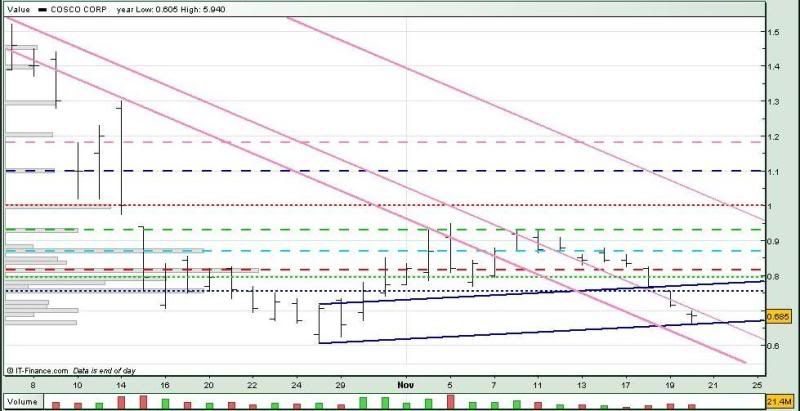
For tomorrow :
Support @ 0.665 (low blue, mid pink), 0.585 (low pink)
Resistance @ 0.715, 0.755 (blue ...), 0.775 (upp blue), 0.795 (green ...), 0.815 (red --)
Tomorrow could be crucial for Cosco as we may see it testing the 0.605 low of 28 oct again if it breaks the 0.665 support, where the uptrend support (low blue) meets the downtrend resistance (mid pink).

For tomorrow :
Support @ 0.665 (low blue, mid pink), 0.585 (low pink)
Resistance @ 0.715, 0.755 (blue ...), 0.775 (upp blue), 0.795 (green ...), 0.815 (red --)
China Hongx 201108
China Hongxing today opened and closed right on the long term downtrend support (mid red). China Hongxing also tested the 0.180 support (lightblue ...) after breaking the 0.205 support (blue --) on 18 nov, 1 day after our last discussion.
China Hongxing also formed a Doji today. Since China Hongxing has been sliding over the last few days, a Doji usually indicates a rebound. That would have to depend if China Hongxing can maintain trading above the 0.180 support (lightblue ...) at least.
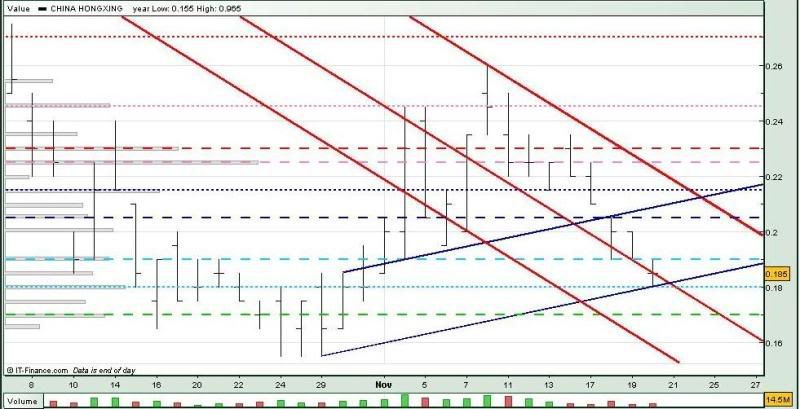
For tomorrow :
Support @ 0.182 (low blue), 0.180 (mid red, lightblue ...), 0.170 (green --), 0.154 (low red)
Resistance @ 0.190 (lightblue --), 0.205 (blue --), 0.210 (upp blue), 0.215 (blue ...)
China Hongxing also formed a Doji today. Since China Hongxing has been sliding over the last few days, a Doji usually indicates a rebound. That would have to depend if China Hongxing can maintain trading above the 0.180 support (lightblue ...) at least.

For tomorrow :
Support @ 0.182 (low blue), 0.180 (mid red, lightblue ...), 0.170 (green --), 0.154 (low red)
Resistance @ 0.190 (lightblue --), 0.205 (blue --), 0.210 (upp blue), 0.215 (blue ...)
Noble Group 191108
A breakdown with high volume usually means bad news (for longists). Volume support looks to be around 0.650 - 0.655 (red --). If Noble Group doesn't break the uptrend support (low blue - now turned resistance) soon, we could see Noble Group eventually hitting 0.600 as indicated by the downtrend support (low pink).
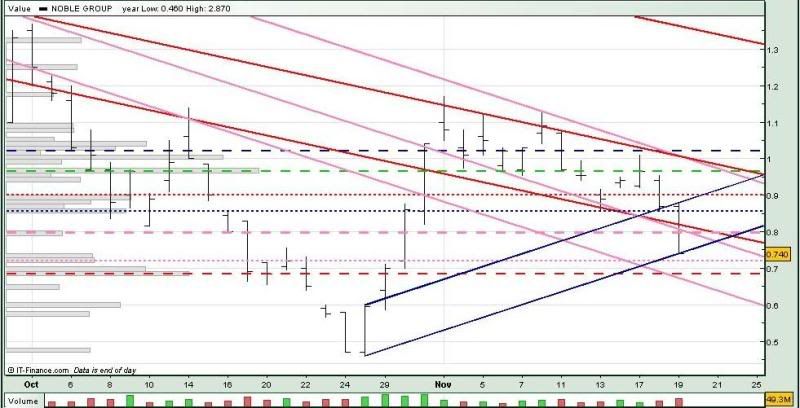

Shipping stocks
The Korea Shipowners' Association said it may set up an asset management company to buy vessels from cash- strapped shipping lines as trade slows amid the global financial crisis.
STX Pan Ocean Co. (STX SP), South Korea's largest bulk- shipping line, decreased 2.5 cents, or 3.2 percent, to 76 Singapore cents. Neptune Orient Lines Ltd. (NOL SP), Southeast Asia's biggest container carrier, declined 4 cents, or 3.9 percent, to 99 Singapore cents.
STX Pan Ocean Co. (STX SP), South Korea's largest bulk- shipping line, decreased 2.5 cents, or 3.2 percent, to 76 Singapore cents. Neptune Orient Lines Ltd. (NOL SP), Southeast Asia's biggest container carrier, declined 4 cents, or 3.9 percent, to 99 Singapore cents.
Wednesday, November 19, 2008
Wave of heavy selling hits bourses
by R SIVANITHY (19 Nov)
Worries that Wall Street might tank send STI below 1,700; one billion units worth $863 million traded
THE region's stock markets were engulfed by a wave of heavy selling yesterday afternoon, resulting in the Straits Times Index (STI) losing the 1,700 mark when it plunged 57.12 points or 3.3 per cent to 1,692.55.
As always, expectations of how Wall Street might perform later in the day provided the main impetus, which means that going by yesterday's loss, the US market could tank when it opens.
Hong Kong's Hang Seng Index was also instrumental in setting the tone, with a 4.5 per cent loss. In addition, China's indices collapsed almost 7 per cent and Europe opened with an average loss of 1.5 per cent.
Turnover, which was poor before lunch, picked up in the afternoon. Excluding foreign currency issues, one billion units worth $863 million were traded, up from Monday's weak $638 million but still below last week's low average of $950 million.
Brokers said news that Citigroup plans to lay off 50,000 staff worldwide provided a sobering reminder to many investors that the downturn is only just starting.
In a Nov 14 report on Asia-Pacific banks, Morgan Stanley analyst Matthew Wilson said that in the current environment, earnings visibility is very poor and using book value as a gauge of value can be a problem.
'At this stage we have no clear view on the likely depth and breadth of the credit and macro cycle,' he said. 'Book value is a function of accounting. Consequently, it usually differs materially from economic value.'
In particular, Mr Wilson said goodwill impairment is a risk, and he sees no fundamental reason why investors should pay a multiple on goodwill. Nine Asian banks were identified for which goodwill accounts for more than 25 per cent of book value, among them DBS. The stock dropped 20 cents to $9.90 yesterday with 8.1 million done.
The property sector took a hit after news that a record low 112 units were sold in October and that some buyers were returning units. Goldman Sachs said yesterday it is cautious on developers, with a 'sell' on City Developments and Wing Tai because of their exposure to the prime residential segment.
The broker said that even though developer stocks are trading at an average 46 per cent discount to net asset values, it still prefers selected commercial real estate investment trusts. CityDev plunged 50 cents or 8 per cent yesterday to $5.75.
Elsewhere, commodities play Olam International was the subject of differing broker recommendations. JP Morgan, for example, in a Nov 14 report called an 'overweight' on Olam with a $1.19 price target, describing the company's first-quarter 2009 results as encouraging.
Merrill Lynch, on the other hand, on Monday rated Olam an 'underperform', down from 'neutral' and with a $1 price target. 'Our price objective is based on the Gordon growth model and implied 1.5x book.
We have cut our FY09/10 estimates by 10-18 per cent and expect lower sustainable ROE (return on equity) of 16-17 per cent as the company adopts a less geared capital structure,' said Merrill Lynch. Olam dropped 16 cents to $1.06 yesterday.
The US investment bank also downgraded another commodity firm, the Noble Group, setting a 70-cent price target compared with $3.15 previously. 'We acknowledge the stock is down 50 per cent since September but believe there is more downside risk given our prognosis that the slowdown in commodity trade will stretch into 2009,'
Merrill Lynch said. 'The stock traded at 0.6-0.7x in the 1999/2000 post-Asian crisis period and 0.8x during Sars and 9/11. We think it could trade at those levels again.' Noble ended 9.5 cents down at 87 cents yesterday.
-Research Report by R SIVANITHY (19 Nov)
Worries that Wall Street might tank send STI below 1,700; one billion units worth $863 million traded
THE region's stock markets were engulfed by a wave of heavy selling yesterday afternoon, resulting in the Straits Times Index (STI) losing the 1,700 mark when it plunged 57.12 points or 3.3 per cent to 1,692.55.
As always, expectations of how Wall Street might perform later in the day provided the main impetus, which means that going by yesterday's loss, the US market could tank when it opens.
Hong Kong's Hang Seng Index was also instrumental in setting the tone, with a 4.5 per cent loss. In addition, China's indices collapsed almost 7 per cent and Europe opened with an average loss of 1.5 per cent.
Turnover, which was poor before lunch, picked up in the afternoon. Excluding foreign currency issues, one billion units worth $863 million were traded, up from Monday's weak $638 million but still below last week's low average of $950 million.
Brokers said news that Citigroup plans to lay off 50,000 staff worldwide provided a sobering reminder to many investors that the downturn is only just starting.
In a Nov 14 report on Asia-Pacific banks, Morgan Stanley analyst Matthew Wilson said that in the current environment, earnings visibility is very poor and using book value as a gauge of value can be a problem.
'At this stage we have no clear view on the likely depth and breadth of the credit and macro cycle,' he said. 'Book value is a function of accounting. Consequently, it usually differs materially from economic value.'
In particular, Mr Wilson said goodwill impairment is a risk, and he sees no fundamental reason why investors should pay a multiple on goodwill. Nine Asian banks were identified for which goodwill accounts for more than 25 per cent of book value, among them DBS. The stock dropped 20 cents to $9.90 yesterday with 8.1 million done.
The property sector took a hit after news that a record low 112 units were sold in October and that some buyers were returning units. Goldman Sachs said yesterday it is cautious on developers, with a 'sell' on City Developments and Wing Tai because of their exposure to the prime residential segment.
The broker said that even though developer stocks are trading at an average 46 per cent discount to net asset values, it still prefers selected commercial real estate investment trusts. CityDev plunged 50 cents or 8 per cent yesterday to $5.75.
Elsewhere, commodities play Olam International was the subject of differing broker recommendations. JP Morgan, for example, in a Nov 14 report called an 'overweight' on Olam with a $1.19 price target, describing the company's first-quarter 2009 results as encouraging.
Merrill Lynch, on the other hand, on Monday rated Olam an 'underperform', down from 'neutral' and with a $1 price target. 'Our price objective is based on the Gordon growth model and implied 1.5x book.
We have cut our FY09/10 estimates by 10-18 per cent and expect lower sustainable ROE (return on equity) of 16-17 per cent as the company adopts a less geared capital structure,' said Merrill Lynch. Olam dropped 16 cents to $1.06 yesterday.
The US investment bank also downgraded another commodity firm, the Noble Group, setting a 70-cent price target compared with $3.15 previously. 'We acknowledge the stock is down 50 per cent since September but believe there is more downside risk given our prognosis that the slowdown in commodity trade will stretch into 2009,'
Merrill Lynch said. 'The stock traded at 0.6-0.7x in the 1999/2000 post-Asian crisis period and 0.8x during Sars and 9/11. We think it could trade at those levels again.' Noble ended 9.5 cents down at 87 cents yesterday.
-Research Report by R SIVANITHY (19 Nov)
Singapore Strategy
by CIMB-GK RESEARCH (18 Nov)
THE Q3 2008 earnings season has just concluded. Despite marked-down expectations by our analysts, the number of companies with earnings misses still outnumbered those that sprang positive surprises by 2:1.
Sectors that disappointed this quarter were banks, transport, telcos, manufacturing and S-chips. Sectors that beat expectations were plantations and offshore and marine. In the past three months, we had pulled down our expectations for Straits Times Index (STI) EPS growth.
We now expect STI earnings to contract 6.3 per cent y-o-y in 2008 and 13.7 per cent y-o-y in 2009. The bulk of our earnings cut came in October/November - we chopped our estimates for STI 2008 EPS by 8 per cent and 2009 EPS by 27 per cent in that period. Whether these expectations are low enough remains to be seen. STI earnings fell on average 28 per cent in 1997/98, 2001 and 2003.
Few places to hide in a global recession: In the past three months, the MSCI Singapore Free Index fell 39 per cent. In Singapore, the banking, property, real estate investment trust (Reit), multi-industry, plantations, transport and manufacturing sectors underperformed the index.
The two worst-hit sectors were plantations and transport, as commodity prices went into free fall and the shipping sector suddenly saw demand evaporate, largely from the developed world. Only telcos, media and services outperformed the index.
Our top picks: As the STI attempts to find its floor in the next six to nine months, stocks that we like are either stable, cash businesses that provide decent yields despite recessions or stocks that will emerge from this recession for the better, benefiting from a strong balance sheet now or in a position to emerge as leaders in their industries. The opportunity to pick these stocks at marked-down valuations is their key attraction.
In the former category, the stocks include MobileOne (M1), Singapore Post, ComfortDelGro, Cerebos Pacific, Parkway Life Reit, Sembcorp Marine, Singapore Press Holdings and SP Ausnet. In the latter category, our favoured stocks are Parkway Holdings, CapitaCommercial Trust, Wheelock Properties, City Developments, Venture Corp, Singapore Exchange and Wilmar.
For the next six months, our preferred sectors are media, S-Reits and telcos. The sectors we are wary of are banks, property, transport and consumer discretionary.
We view recent rallies as relief rallies from oversold positions. As the market grapples with the realities of a recession, we expect the STI to lose ground and find a floor anywhere between 1,200 and 1,600 - recession P/B levels.
As companies streamline their cost structures and as governments pump-prime in zest and cut interest rates to near zero in the coming months, we expect the seeds to be sown for an eventual recovery from H2 2009. By our estimation of the typical duration of a recession, a market bottom in mid-2009 seems likely. Our end-2009 STI target is set at 2,040, based on a bottom-up methodology.
-Research Report by CIMB-GK RESEARCH (18 Nov)
THE Q3 2008 earnings season has just concluded. Despite marked-down expectations by our analysts, the number of companies with earnings misses still outnumbered those that sprang positive surprises by 2:1.
Sectors that disappointed this quarter were banks, transport, telcos, manufacturing and S-chips. Sectors that beat expectations were plantations and offshore and marine. In the past three months, we had pulled down our expectations for Straits Times Index (STI) EPS growth.
We now expect STI earnings to contract 6.3 per cent y-o-y in 2008 and 13.7 per cent y-o-y in 2009. The bulk of our earnings cut came in October/November - we chopped our estimates for STI 2008 EPS by 8 per cent and 2009 EPS by 27 per cent in that period. Whether these expectations are low enough remains to be seen. STI earnings fell on average 28 per cent in 1997/98, 2001 and 2003.
Few places to hide in a global recession: In the past three months, the MSCI Singapore Free Index fell 39 per cent. In Singapore, the banking, property, real estate investment trust (Reit), multi-industry, plantations, transport and manufacturing sectors underperformed the index.
The two worst-hit sectors were plantations and transport, as commodity prices went into free fall and the shipping sector suddenly saw demand evaporate, largely from the developed world. Only telcos, media and services outperformed the index.
Our top picks: As the STI attempts to find its floor in the next six to nine months, stocks that we like are either stable, cash businesses that provide decent yields despite recessions or stocks that will emerge from this recession for the better, benefiting from a strong balance sheet now or in a position to emerge as leaders in their industries. The opportunity to pick these stocks at marked-down valuations is their key attraction.
In the former category, the stocks include MobileOne (M1), Singapore Post, ComfortDelGro, Cerebos Pacific, Parkway Life Reit, Sembcorp Marine, Singapore Press Holdings and SP Ausnet. In the latter category, our favoured stocks are Parkway Holdings, CapitaCommercial Trust, Wheelock Properties, City Developments, Venture Corp, Singapore Exchange and Wilmar.
For the next six months, our preferred sectors are media, S-Reits and telcos. The sectors we are wary of are banks, property, transport and consumer discretionary.
We view recent rallies as relief rallies from oversold positions. As the market grapples with the realities of a recession, we expect the STI to lose ground and find a floor anywhere between 1,200 and 1,600 - recession P/B levels.
As companies streamline their cost structures and as governments pump-prime in zest and cut interest rates to near zero in the coming months, we expect the seeds to be sown for an eventual recovery from H2 2009. By our estimation of the typical duration of a recession, a market bottom in mid-2009 seems likely. Our end-2009 STI target is set at 2,040, based on a bottom-up methodology.
-Research Report by CIMB-GK RESEARCH (18 Nov)
Olam 181108
Olam broke 3 supports yesterday, which included the long term downtrend support (low red) and 1.09 neckline (red --). As we already know now, Olam is plunging.
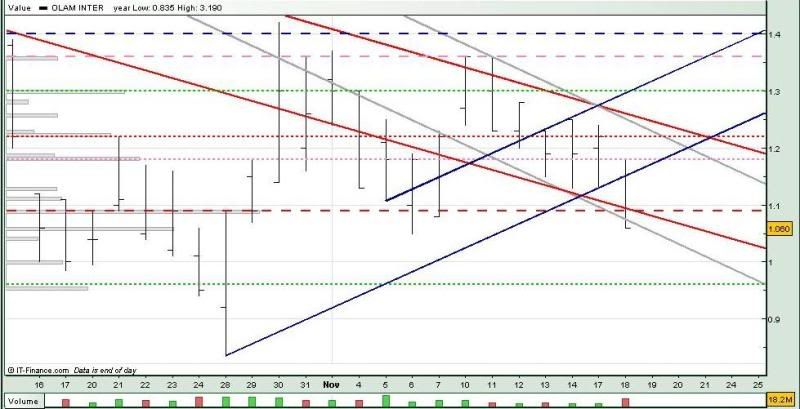
Looking at the chart, some possible supports could be at :
1.04 (20 oct doji) - broke
1.00 (round number support) - broke
0.960 (green ...) - ???

Looking at the chart, some possible supports could be at :
1.04 (20 oct doji) - broke
1.00 (round number support) - broke
0.960 (green ...) - ???
Monday, November 17, 2008
Noble Group 171108
Noble Group once again keeps everyone on their toes (and guessing) by closing right on the 0.965 support/resistance (green --) today. However, as you can see from the chart, Noble Group is still trading within the uptrend channel (blue).
The 1.02 resistance (blue --) still remains a formidable, but not impossible, block for Noble Group to overcome.
If Noble Group can remain trading within the uptrend channel, and above 0.955 (mid pink meets low blue) ideally, we could see Noble Group knocking on the 1.02 resistance in no time. If that happens, we could see Noble Group go on another one of its dizzying runs, just like it did on 28 oct. However, don't forget that its falls are equally scary - just look at 14 oct and you should know.
Either way, be prepared for another roller-coaster ride!
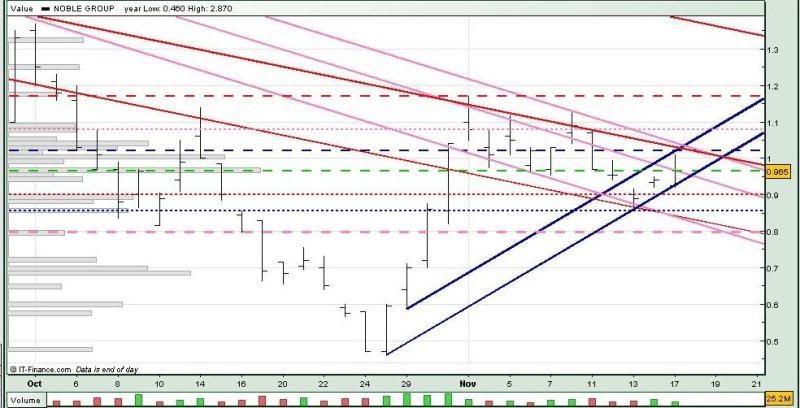
For tomorrow :
Support @ 0.965 (green --), 0.955 (low blue, mid pink), 0.900 (red ...), 0.855 (blue ...), 0.833 (low red), 0.822 (low pink), 0.795 (pink --)
Resistance @ 0.965 (green --), 1.02 (upp pink, mid red, blue --), 1.05 (upp blue), 1.08 (pink ...)
The 1.02 resistance (blue --) still remains a formidable, but not impossible, block for Noble Group to overcome.
If Noble Group can remain trading within the uptrend channel, and above 0.955 (mid pink meets low blue) ideally, we could see Noble Group knocking on the 1.02 resistance in no time. If that happens, we could see Noble Group go on another one of its dizzying runs, just like it did on 28 oct. However, don't forget that its falls are equally scary - just look at 14 oct and you should know.
Either way, be prepared for another roller-coaster ride!

For tomorrow :
Support @ 0.965 (green --), 0.955 (low blue, mid pink), 0.900 (red ...), 0.855 (blue ...), 0.833 (low red), 0.822 (low pink), 0.795 (pink --)
Resistance @ 0.965 (green --), 1.02 (upp pink, mid red, blue --), 1.05 (upp blue), 1.08 (pink ...)
Indofood Agri 171108
Indofood Agri has been on the slide ever since hitting a high of 0.650 on 10 nov, and today is the fifth day that Indofood Agri is down, breaking the downtrend support (mid red) too.
We could see Indofood Agri rebounding once it hits the 0.420 support (pink --), but any upside could be limited to the 0.470 resistance (green --). If the 0.420 support breaks, we could see Indofood Agri retest 0.370 (28 oct low).
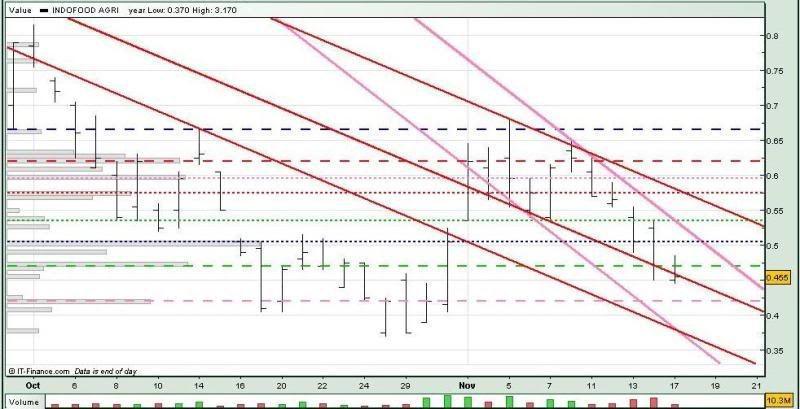
For tomorrow :
Support @ 0.445 (mid red), 0.420 (pink --), 0.367 (low red), 0.357 (low pink)
Resistance @ 0.470 (green --), 0.505 (blue ...), 0.515 (upp pink), 0.535 (green ...)
We could see Indofood Agri rebounding once it hits the 0.420 support (pink --), but any upside could be limited to the 0.470 resistance (green --). If the 0.420 support breaks, we could see Indofood Agri retest 0.370 (28 oct low).

For tomorrow :
Support @ 0.445 (mid red), 0.420 (pink --), 0.367 (low red), 0.357 (low pink)
Resistance @ 0.470 (green --), 0.505 (blue ...), 0.515 (upp pink), 0.535 (green ...)
China Hongx 171108
As you can see from the chart, China Hongxing broke 3 rather important supports today - uptrend support (low blue), 0.225 support (pink --) and 0.215 support (blue ...).
The next important support for China Hongxing would be the 0.205 support (blue --). If that is broken, we could see China Hongxing going on a free fall like it did on 15 oct.
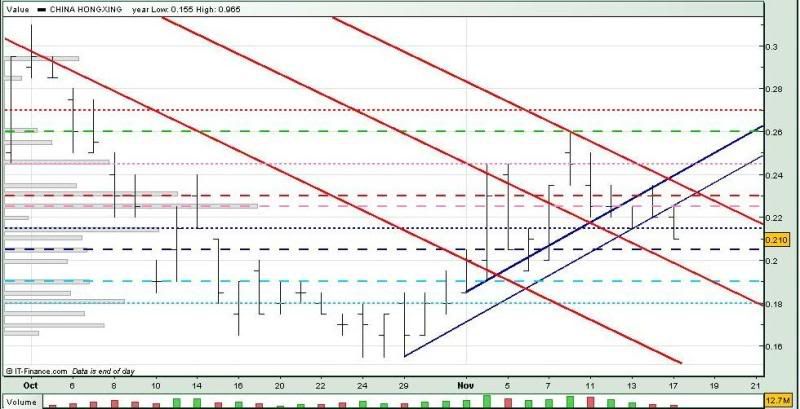
For tomorrow :
Support @ 0.205 (blue --), 0.195 (mid red), 0.190 (lightblue --), 0.180 (lightblue ...)
Resistance @ 0.225 (pink --), 0.230 (red --), 0.232 (low blue, upp red), 0.245 (upp blue, pink ...)
The next important support for China Hongxing would be the 0.205 support (blue --). If that is broken, we could see China Hongxing going on a free fall like it did on 15 oct.

For tomorrow :
Support @ 0.205 (blue --), 0.195 (mid red), 0.190 (lightblue --), 0.180 (lightblue ...)
Resistance @ 0.225 (pink --), 0.230 (red --), 0.232 (low blue, upp red), 0.245 (upp blue, pink ...)
Subscribe to:
Posts (Atom)


 Posts
Posts


